Friday, October 06, 2006

NAWU Branches June 1914

NAWU Branches June 1914

Abergavenny

Aylesbury

Banstead

Barnsley Hall

Bexley

Birmingham

Bodmin

Brentwood

Brookwood

Cane Hill

Cardiff

Carmarthen

Caterham

Chester

Claybury

Colney Hatch

Darenth

Derby

Devizes

Durham

Earlswood

Epsom

Exminster

Fareham

Garlands

Gloucester

Hanwell

Hayward's Heath

Hellingly

Hereford

Hill End

Hull

Killarney

Lancaster

Leavesden

Lincoln

Macclesfield

Maidstone

Menston

Mickleover

Middlesbrough

Middlesex

Morpeth

Napsbury

Netheme

Newport

Northfield

Norwich

Oxford

Portsmouth

Prestwich

Rainhill

Scalebor Park

Storthes Hall

Tooting

Wadsley

Wakefield

Wallingford

West Ham

Winwick

Central Branch

Aberdeen

Bridgend

Cotford

Dorset

Dublin

Earlswood

Fulford

Hill End

Kilkenny

Portrane

Powick

Three Counties

Whittingham

York


National Asylum Workers Union Branches 1914

COHSE Guilds Circa 1947

COHSE Rule 8.—COHSE GUILDS.

(i) Members of the Union shall be further classified into Guilds, to ensure that the professional and. special interests, which are not common to all members, are preserved and secured. Members shall, therefore, be classified into the following Guilds ;—

(a) Clerical and Administrative Guild.

(b) Guild of Nurses.

(c) Guild of Mental Nurses and Mental Deficiency Nurses.

(d) Medical Services Guild.

(e) Ambulance Services Guild.

(f) General Health Service Employees'Guild.

(g) Voluntary Hospitals Guild, pending the introduction of some scheme of complete unification as envisaged by the Government's proposals.

(ii) Each Regional Council, when established, shall consider the development of the Guild system, and in such cases as the membership demand, permission shall be given for any of the Guilds within the Region to establish a small representative Committee of the members of the Guild to advise the Regional Council or its Executive Committee on any matter peculiar to the particular Guild. Such Committees may submit resolutions to the Regional Council or Regional Executive Committee for consideration. It must be clearly defined that vital questions of policy affecting the Union as a National entity are not to be considered by these Committees, but by the established Branches and Regional Councils.

(iii) Separate Guild Branches are not to be established. The whole of the membership in any Hospital, Institution, or Department is to be contained in the one established Branch. It shall be. the duty of the established Branch to appoint, as far as practicable, Sectional or Guild Collectors, and to ensure that on the Branch Executive Committee direct representation of the section is afforded, based on membership.

(iv). The rational Executive Committee shall be empowered to receive a deputation from any of the established Guilds on matters solely related to the professional or special interests of the particular Guild.

(v) The National Executive Committee shall be empowered, in such particular Guild as it feels necessary", to establish a small National Advisory Committee of such Guild, consisting of representatives of the Regions for the purpose of acting as an advisory Committee to the National Executive Committee or, for any particular Guild on any specific issue arising, to call a representative conference of regional representatives of the particular Guild concerned.

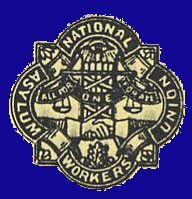
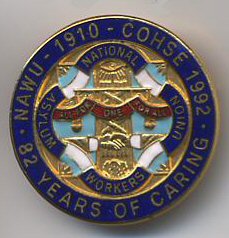
NAWU badge 1914


Is There Any Demand for a Union Badge ?

For two years or so the question of a union badge has graced the agendas of successive Executive Council meetings and Annual conferences; and time after time the subject has been left “to lie on the table”, which in other words means that it is not considered to be of such pressing importance that time need be wasted in discussing it.

Now there must of necessity, be either demand for a badge, or no demand for one, and in the latter case the matter might just as well be dropped straight away and have done with it.

On the other hand, judging by the correspondence received at headquarters from time to time, there does appear to be a a genuine demand from many quarters. And it has been suggested to us that if the Union does not soon adopt an official badge the London County Council section of the Union will obtain one of their own!

This, of course, would be an undesirable (and we might add, unauthorised) proceeding, and it would be a ridiculous state of affair, for different " Circles" of the Union to have different kinds of badges. We must have unity on the badges' question as on any other.

We believe we are right in stating that as a Union without a badge we are somewhat unique in the trade union world, and our own opinion is that thew N.A.W.U (National Asylum Workers Union) will eventually find, as apparently all other Trade Unions have found, that a distinctive emblem of the Society is not only a valuable organising agent, but has a great moral effect upon the loyalty of existing (but " shaky ") members.

The accompanying draft badge (specially designed in colour, for us by Messrs Fattorini, of Bradford, who also kindly supplied the block) is reproduced in order

that members may have an opportunity of judging for themselves whether an artistic badge would be invaluable asset to the NAWU Union or a wasteful extravagance.

The badge would, of course, be enameled-faced in beautiful colours, and could be made in the form of pendants or studs for men, and brooches for the ladies The design reproduced on this page is the actual site of the suggested badge.

The few objections we have heard to the badge idea are herewith disposed of;—

  1. The authorities would not allow them to be worn Answer: Some would; some wouldn’t. In any case the authorities could not prevent the wearing of a pendant on a watch-chain while on duty. decent badge could be worn when off duty

2: Members who lapsed, having paid for the badges could still wear them, even though no longer members of the union

Answer: They could , but they wouldn’t if they were pilloried in the Magazine for wearing a union badge when no longer members, In this case, of course, the local Branches should be empowered to buy back the badges from lapsed members.

Are there any other objections ?

We shall be glad to hear from ALL Branches on the subject, favorably or otherwise.

National Asylum Workers Union Magazine 1914

NAWU badges 9d each, silver badges 4s 6d and gold badges £1 each

Thursday, October 05, 2006

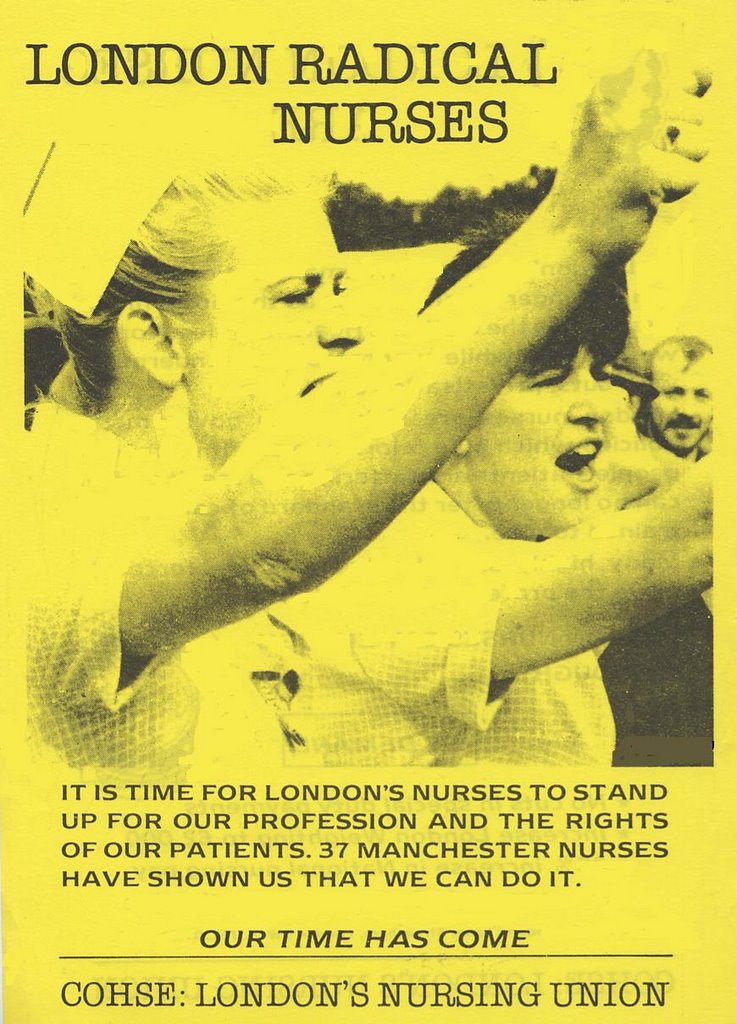
COHSE London Radical Nurses 1988


COHSE London Radical Nurses 1988 Leaflet

As London's nurses we demand action now.
We can no longer sit and watch as the Government dismantles the National Health Service.
Nor can we just wait while our profession is undermined with cuts, privatisation and low pay.


London nurses are sick of the governments policies which give priority to profit instead of people. Patients are suffering as a result and we can no longer offer the standard of care we are trained to give, Many highly skilled colleagues are forced to leave the profession due to low pay.


* No cuts in special duty payments


* Increase London Weighting to £2,000

*20% increase in National nursing pay

*No more cuts & no more privatisation

COHSE 112 Greyhound Lane, Streatham, London, SW16
COHSE: London's Nursing Union

Wednesday, October 04, 2006

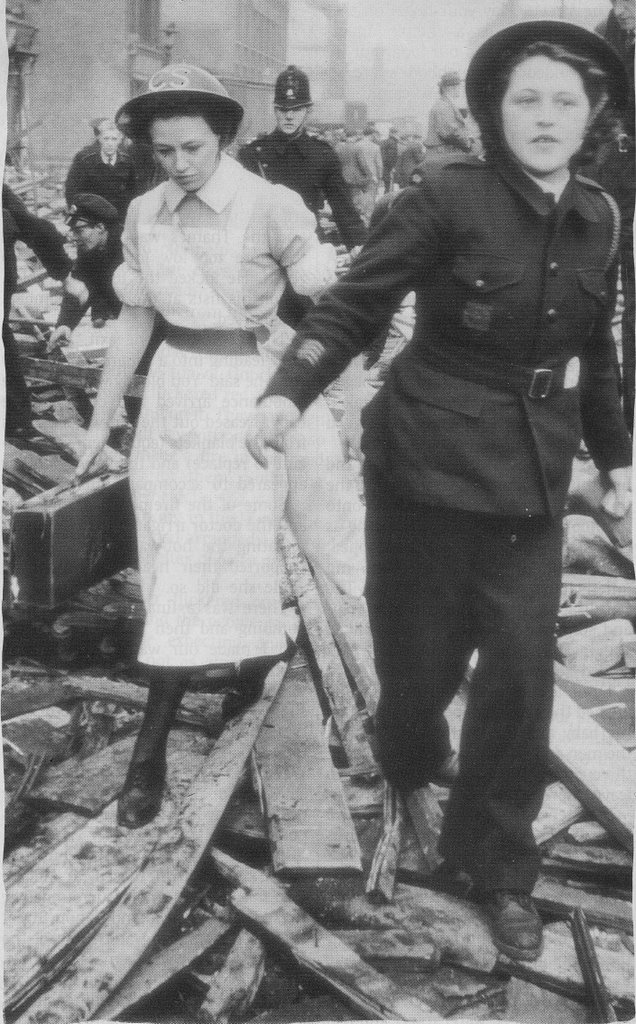
London Blitz 1940


Daily Herald

Friday 15th November 1940

Night Raiders Bomb 2 London Hospitals
By Frank Smith Herald Reporter

Sixty old women, all bedridden chronic patients, were in bed in the ward of a London hospital last night when a high explosive bomb crashed through the building and exploded on the ground floor.The bomb fell before the alert was sounded.

Nurses, doctors, students and porters rushed to the spot and found one end of
the ward a, heap of smoking rubble with beds and patients buried beneath it.

Digging Into the debris with their bare hands, they soon reached some of the women, and within half an hour had cleared the block.

Three of the patients and a sister, however, had been killed by the explosion.

Four Fell

Four bombs fell on the hospital premises; three burst in the grounds, doing no damage.

It was the fourth which hit the chronic patients" block, a 'three-storied building, and plunged through two floors before exploding on the ground floor where the old women had been taken for extra safety.

"I cannot speak highly enough of the work of the staff," the Medical Superintendent told me.

“I soon reached the bombed block, but when I got there I found the nurses going calmly round the litter-covered beds soothing the patients”

"Male members of the staff were already searching the debris, and the co-operation of everyone was magnificent.

Remained Calm

"One end •of the ward was demolished, but there was another door the other end, and we were able to get the-patients out that way

‘All the patients are somewhere around eighty years old, and a few of them were in tears, but the majority remained calm all through the ordeal."

Houses near the hospital were also hit, and people were buried beneath the debris,

Bombs also fell on a maternity hospital in the London area. Mothers, babies and staff escaped.There were I8 mothers and I4 babies in a specially-protected ward on the ground floor,

Causalities were caused when bombs fell on a London school used as an A.F.S and Ambulance station

London Blackout;

5.39pm.-7.51 am

MOON RISES 5.52pm

NOTE: This sound like the bombing of the Royal London Hospital

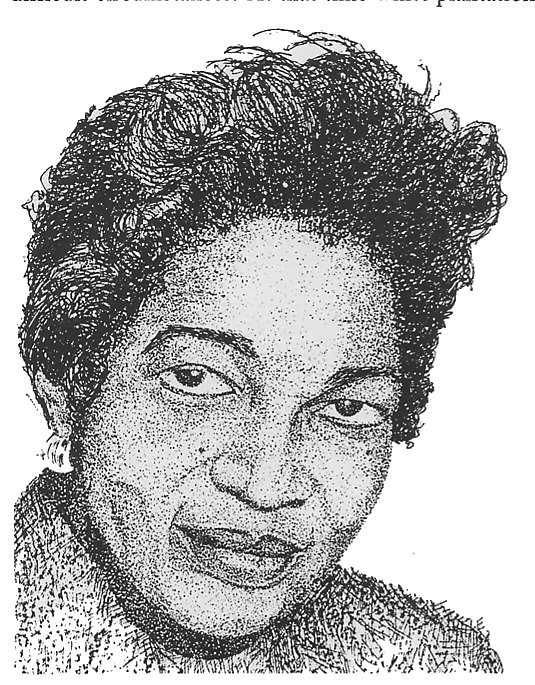
Afro-Asian West Indian Nurses Association 1960

Afro-Asian West Indian Nurses Association circa 1960

This organisation for nurses was probably the first “black section” of any trade union.

Established in the late 1950’s this organisation was not a trade union but a “social welfare” organisation promoted by Claudia Jones at the West Indian Gazette. Which had been “very helpful”

To be a member of the A.A.W.I.N.A. you had also to be a member of the Confederation of Health Service Employees (COHSE).

The organisation had played a key role in recruiting “coloured nurses” in London hospitals.

The Secretary was Mr Sealy and the Regional Organiser was Mr McNeelance

Lesbian & Gay Rights


1987 COHSE Conference set its face firmly against discrimination against gay men and lesbians with a call to support equal opportunities at work and in the trade union and Labour movement.

Michael Walker moved the resolution calling on COHSE “to ensure that all our members could live without fear of persecution”. Roy Oliver, (Reading and District branch) (right)told delegates: 'Discrimination exists in all walks of life. For the gay community it condemns us to hide, to 'As one of our great writers put it, "The love that dare not speak its name".'Gay people, he said, were experiencing a disease 'that takes then" loved ones from them, sometimes

after 15 or 20 years', and yet The Sun newspaper was holding 'We need positive images to change attitudes,' he said. 'We need education.' right. We ask to be treated as people with feelings who care and who love one another. We ask to be treated as Tony Ventham, (Park Royal Ambulance branch)supporting resolution 90. said: 'The question of gay rights and the question of people being split from each other in the workplace.

But Alan Couch, Cefn Coed, spoke against the resolution. 'The best interests of society in this matter would be best served by a further Royal Commission,'
he suggested.

COHSE National Officer Judith Carter speaking for the NEC, called for support for the resolution.

'The whole question of AIDS has brought this issue sharply into focus,' she said. 'Gays and lesbians face discrimination in terms of their ability to obtain and

hold jobs and houses and there have been many instances of them being deprived of the custody of their children.

'As trade unionists we should be concerned at the hysteria which surrounds this issue. 'As trade unionists, as COHSE trade unionists, we need to insist that a person's sexuality is nothing to do with his or her ability to do the job.'

The resolution was carried.

Lesbian & Gay Rights

Resolution 90 COHSE Conference 1987

That this Conference opposes all discrimination against Lesbian and gay men and recognises that this discrimination is institutionalised in society as it is in the National Health Service.

Conference therefore welcomes and reaffirms COHSE's support for the lesbian and gay resolutions passed at the 1985 and1986 TUC and Labour Party Conferences and calls on the National Executive Committee to:

(i) oppose all discrimination against lesbian and gay men in the Health Service and in the trade union and Labour movement;

(ii) support the Labour councils' introduction of comprehensive equal opportunities policies including 'positive images' of lesbian and gay men such as in Ealing and Haringey Council;

(iii) support for district health authorities who have introduced comprehensive equal opportunities with union support;

(iv) campaign for all District Health Authorities to include in their equal opportunities policy opposition to discrimination against lesbian and gay men;

(v) support the awareness of lesbian and gay issues within COHSE and the trade union and Labour movement;

(vi) affiliate to the Labour Campaign for Lesbian and Gay Rights and support the
LCLGR Charter.

COHSE 618 HILLINGDON AND DISTRICT BRANCH

CARRIED

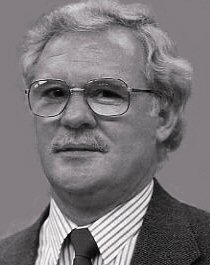
Colin Robinson COHSE President 1987-1993


COHSE Conference 1987

Former Vice President Colin Robinson (Maidstone) was swept into office of National President by a massive majority over two rival candidates.

His success marks the culmination of a steady rise through the ranks of COHSE’s lay officer position with 14 years experience as a member of the COHSE National Executive and five years as Vice President (1982-1987).

Speaking after his election, he told conference: I don’t think I have been as excited since I got married. I hope it lasts as long.

And he told delegates how he saw the job: “Presidents do not and should not decide the tactics and policies of unions. If our President has a role it is as Chairman of the COHSE National Executive Committee and conference, and to act as guardian “ he said. He went on “The style of the Presidency I will change, but the rules and constitution. The order of our union will not be changed and manipulated unless by the democratic voice of this conference”

Colin a clinical nurse manager with Maidstone Health authority, will now hold the post for three years.

Colin held the post until the formation of UNISON in 1993


COHSE PRESIDENT ELECTION RESULT

Colin Robinson (Maidstone) 2,569

Kevin Mullins (High Royds, Leeds) 360

George Coomber (Royal Earlswood, Redhill) 226

Sunday, October 01, 2006

NAWU First Conference 1911

National Asylum Workers Union (NAWU) First delegete conference Saturday 8th July 1911 at the Pitman's Hotel, Birmingham.

Mr Edward (Ted) Edmondson (President)
Mr George Gibson ( Vice President)

Mr R. Hudson (Trustee)
Mr J. Hankinson (Trustee)
Mr J. W. Shanks (General Treasurer)

Miss K. E. Allen (Winwick Asylum)
Mr J. O'Donnell (Banstead Asylum)
Mr F. Faggattee (Bexley Asylum)
Mr G. H. Jewell (Bodmin Asylum)
Mr G. Stone (Caterham Asylum)
Mr D. G. Williams (Cardiff Asylum)
Mr J. McGettrick (Chester Asylum)
Mr F. Donny (Claybury Asylum)
Mr F. S. Eager (Exminister Asylum)
Mr A. Miles (Hellingly Asylum)
Mr J. W. Gold (Lancaster Asylum)
Mr H. Howlett (Leavesden asylum)
Mr F. Mosses (Maidstone Asylum)
Mr S. Gordon (Menston Asylum)
Mr G. E. Hopton (Norwich Asylum)
Mr T. Smith (Prestwich Asylum)
Mr W. Davis (Rainhill Asylum)
Mr E. Lapish (Storthes Asylum)
Mr H. Shaw ( Wakefield Asylum)
Mr T. Bertram (York Asylum)

also

Mr Baker, Isworth, Paterson, and Vernon NEC members
and Mr Bankart General Secretary


Unable to send delegates:
Abergavenny Asylum, Talgarth Asylum, Colney Hatch Asylum, Darenth Asylum, Hanwell Asylum, Aylesbury Asylum, Haywards Heath Asylum, and Narboro Asylum

A total NAWU membership of 4,400 spread over 44 Asylums


The first NAWU meeting July 1910


First meeting of the National Asylum Workers Union held at the

Mason' Arms Hotel, Whitefield, Manchester on Saturday 9th July, 1910.


In attendance

Prestwich Asylum: Mr J. W. Shanks, Mr Jas Paterson and Mr T. Smith (Mr Guy)

Rainhill Asylum: Mr H. B. Cook, Mr W. H. Spencer, and Mr J. S. Sherlock


Whittingham Asylum: Mr C. Lloyd, Mr C. K. Dean and Mr T. W. Nelson


Lancaster Asylum: Mr E. Edmondson, Mr J. Gold and Mr B. Parkin


Winwick Asylum: Mr F. J. Richmond, Mr J. Brennan, George Gibson
and Mr W. Ellwood (Convenor)

Mr J. W. Shanks was elected Chairman

It was unanimously agreed "to form an organisation for Asylum Workers, and ask for a subscription of 4d per month to defray initial expenses".

Mr George Gibson was elected Honary General Secretary

Apologies from Martin Meehan (Winwick) and key founder member and organiser

Monday, September 25, 2006

Radical Nurses Group (estb 1980)

Radical Nurses

The Radical Nurses Group has been in existence since November 1980. It has set up by and for nurses in all fields because of the dissatisfaction so many of us have about so many aspects of our jobs.

We wanted a way of getting together, to support each other, to help us feel we're not alone, to moan together perhaps, to discuss our common problems but hope-fully also to act together to change things.

The Radical Nurses Group gives as another framework for ail this besides the unions and 'professional organisations'.

It is early days yet. So far we've had two national meetings in London and Sheffield and a third is planned for some- time in April in Manchester. We've also formed regional groupings from these national ones and are beginning to meet at these and even more local levels— town-wide and in individual hospitals.
We have no constitution and not even a set of aims and objectives yet. We're trying to remain as decentralised as possible with a group from each area being alternately responsible for organising the next national meeting and producing a newsletter every three months—of which one has been published so far. Some of the issues we feel are important are:

Staff shortages, sex roles and stereo-typing in nursing, nurses, trade unionism and militancy, nurses roles, especially in relation to doctors, lack of emotional support for nurses and many others—the problem is which to tackle first!
The next national meeting is going to debate the idea of professionalism in nursing and hopefully make some kind of coherent statement about what it actually IS, how it is used and whether it is a concept worth having at all. It's a word which is bandied around in hospitals and the nursing press without ever being defined and it's used to stifle criticism and generally oppress nurses.

For more information and details of contacts in your area please send 6 Stamped address envelopes and £1 to receive regular information and newsletter for the next year to 

Mary Twomey, 51 High Lane, Chorlton, Manchester M21

Radical Nurses
Radical Nurses living in London should contact group at 9 Ryaland Road, London NW5

Gay Lee (article Hospital Worker 1981 )
NOTE:
This small grouping (Radical Nurses Group - RNG) did have a significant impact in the area of politics in nursing, particularly in challenging "stero-typing" of nurses. One of the Groups key exponents went on to be Editor of the Nursing Times (Jane Slavage)
The larger and more established, Association of Radical Midwives (ARM) was a separate organisation which pre dated the Radical Nurses Group

COHSE Officers 1982

COHSE OFFICERS MAY 1982

National President - Sid Ambler

Vice President - Colin Robinson

COHSE Head Office

Glen House, High Street, Banstead, Surrey

General Secretary - Albert Spanswick

Asst General Secretary - David Williams

National Officers

Hector Mackenzie

Colm O’Kane

Terry Mallinson

Rose Lambie

Finance Officer - Robert Farthing

Deputy Finance Officer - Bill Turner

Conference Office - Bill Loftus

Research Officer - Nick Grant

Legal Officer - Alex Heron

Education Officer - Malcolm MacMillan

Press Officer - Nita Clarke

Admin Asst - Joan Reed

Admin Asst - Vivienne Green

Admin Asst - Kitty Tobin

COHSE REGIONS

No. 1 (Northern)
44-46 Grosvenor Road, Jesmond, Newcastle-upon-Tyne 2
Regional Secretary: Andy Vanbeck
Regional Officers: Lisa Brady, Keith Blackburn

No. 2 (Yorkshire and Humberside)
98 Mansfield Road, Intake, Sheffield
Regional Secreatry :Martin Kineavy
Regional Officers: Glyn Robinson, Jean Moxon

No. 3 (North-Western)
381 Bury New Road, Prestwich. Manchester M25 5AW
Regional Secretary :Eric Cooper
Regional Officers: Bob Quick, Terry Foster, Andy Gill

No. 4 (West Midlands)
Dartmouth House, 67 Birmingham Road, West Bromwich, Staffs.
Regional Secretary: Bob Wilshaw
Regional Officers: Leslie Bumford, PaulVaughan

No. 5 (North-East Thames and East Anglia)
42-44 Sewardstone Road, Chingford, London E4 7JW
Regional Secretary: Keith Taylor
Regional Officers: John Wright, Pat Gormley

No. 6 (North-West Thames and Oxford)
112 Greyhound Lane, Streatham, London SW16.
Regional Secretary: Pat McGinley
Regional Officers: Ernie Brook, Niall Sheridan

No. 7 (South-Western)
Silverlea House. 4 Billetfield,
Taunton, Somerset.
Regional Secretary: Ty Taylor
Regional Officers: Trevor Wiggins,Trevor Parsons

No. 8 (South-East Thames)
24 Harmer Street, Gravesend, Kent
Regional Secretary: Bob Harmes
Regional Officers: John Jaggon, Fiona Sloman

No. 9 (Scotland)
28 Leonard Street, Perth.
Also
75 Abbeygreen, Lesmahagow, Lanarkshire
Regional Secretary: Keith Hickson
Regional Officers Bert Dickson, Jimmy Mc Phee

No. 10 (Wales)
32 Gelliwastad Road, Pontypridd, Glamorgan.
Regional Secretary: Ted Davies
Regional Officers: Dick Edwards. Dave Galligan

No. 11 (Northern Ireland)
27 Ulsterville Avenue, Lisburn Road, Belfast
Regional Secretary : Bill Jackson
Regional Officers: Tommy Hughes. Hugh Miskelly

No. 12 (East Midlands)
98 Mansfield Road, Intake, Sheffield
Regional Secretary: Keith Swiffen
Regional Officers: Chris Binks.
Terry Kelly

No. 13 (South-West Thames and Wessex)
63 Victoria Road, Aldershot, Hampshire.
also

112 Greyhound Lane, Streatham, London SW16.
Regional Secretary: lan Dodd
Regional Officers: Judith Carter, Bob Abberley

Sunday, September 24, 2006

COHSE Strike Plan 1982


The COHSE NEC Action Plan

The Action Committee set up by COHSE's National Executive Committee met on 13 April 1982 and drew up a comprehensive range of recommendations for industrial action to be taken up by branches.

The two main forms to be applied within the COHSE guidelines on the protection of patient care and maintenance of emergency services are:

•ban on all non-emergency admissions;

• selective two hour withdrawals of Labour.

A further list was also set out, again within COHSE's Code of Conduct and within the 1979 Joint Agreement on Emergency Services. The proposals, as well as the emergency services agreement, are listed in Head Office Circular 235/82.

Designed to cause the greatest administrative inconvenience to management and least harm to patients, they include:

• ban on private patients' services;

• non co-operation with private contractors;

•refusal by nurses to carry out non-nursing duties, as well as by non-nurses to carry out nursing duties;

•ban on the cleaning of non-clinical areas;

•reduction of output of hospital laundries;

•holding of local demonstrations;

RCN "no opposition" to contacting out - 1989


CONTRACTING OUT OF SERVICES FROM THE NHS
ADVICE PACK FOR RCN MEMBERS

June 1989

WHAT THE POLICY MEANS IN PRACTICE

1. The role of competitive tendering in the NHS

The RCN stance on competitive tendering means that there is no opposition in principle to the concept of contracting out. The College accepts that there may be areas where efficiency savings and/or improvements to services can be made, and that the process of competitive tendering may assist with this. However, it is paramount that the standard of patient care must be at least maintained, and preferably improved. The generation of savings cannot be considered in isolation from other effects of competitive tendering.

The RCN policy aims to ensure that all aspects of services are considered, and that decisions on contracts are based on professional assessment of overall quality of service to patients, not on purely financial grounds.

Experience in the NHS to date has shown that the risk of contracting out is such that the RCN believes it can only be justified if substantial amounts of money are saved and used to the direct benefit of patient care.

NOTE:
This “blinkered” RCN position lead the local RCN officer during the Hillingdon hospital domestic dispute to state that it had nothing to do with nursing

THE NUPE CHARTER FOR MENTAL HOSPITAL EMPLOYEES (1938)


THE NUPE CHARTER FOR MENTAL HOSPITAL EMPLOYEES (1938)


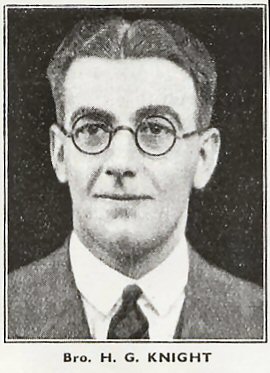
By H.G. Knight R.M.P.A. NUPE London County Council Organiser

1. Hours of DUTY – 96 hour fortnight with complete elimination of the spread-over system

2. OVERTIME – To rank for special duty pay, and “time in lieu” to be discouraged.

3. ANNUAL LEAVE - Indoor Staff: A minimum of one month with full pay; additional leave to be granted in special cases. Outdoor Staff: A minimum of three weeks with full pay.

4. SICK PAY - A minimum of 13 weeks full and 13 weeks half-pay, with extension at the discretion of the Committee. Periods of sickness or accident due to service to be paid at full-salary scale during the whole period absent from duty.

5. PERMANENT DISABILITY - Adequate compensation should be paid in cases of permanent disability arising from cases of disease, illness or injury contracted or sustained during the normal course of duty.

6. RATES OF PAY - Complete revision of present rates of pay and incremental scales.

7. NURSES' HOMES - Nurses should have freedom of choice regarding place of residence, but when Nurses' Homes are established, full amenities for privacy to be provided. Indoor and outdoor facilities for study and recreation.

8. HIGHER GRADE PAYMENTS - Payment for all higher grade duties to commence from the time the duties are undertaken.

9. AFTER-DUTY PASSES - Resident Staff to be brought into conformity with this regulation in the L.C.C. Public Health Department.

10. RESTRICTIONS. - The abolition of all unnecessary restrictions.

If you agree with this Charter and are not already a member of an active trade union, join N.U.P.E. to-day and let us get on with the job.

NUPE Journal June 1938


Hospital Workers Charter

(Circa 1977)

AGAINST ALL CUTS - DEFEND AND IMPROVE THE NHS

No cuts in staff at any level

No cover of unfilled vacancies

No jobs lost : for all trained Hospital Workers

For the improvement of our buildings, facilities and equipment.

NHS staff to replace all voluntary workers , agency workers and outside contractors.

All hospital workers fighting the cuts should campaign in the local TU movement for active support.

WAGES AND CONDITIONS

Against all loss of earnings through cuts in overtime and bonus levels; For a decent living wage for all Hospital Workers.

Against all forms of pay restraint.

For a 35 hour week; without loss of pay, To force more jobs.

FOR STRONG HOSPITAL TRADE UNION ORGANISATION

For 100% Trade Union organisation

Monthly branch meetings in working time

Shop Stewards regularly elected for every department at departmental meetings

No participation in Joint Consultative Committees: for the building of strong Joint Shop Stewards Committees at Hospital, district and area level.

FOR UNION DEMOCRACY

Annual national conferences to be the supreme policy making body

Full-time union officials to be elected annually by the members, on the same pay as the members, and recallable by their members at any time.

SPECIAL DEMANDS

Against all racial discrimination

For the automatic renewal of work permits

For the abolition of private practice inside and outside the NHS

NOTE:

Hospital Worker was primarily a publication of the Socialist Workers Party established in 1973 at conference in Birmingham. In 1975 it dissolved national editions into regionaal broadsheets, but a new national bulliten was re-established in October 1976 which survived until about 1982

By the early 1980’s, the SWP’s increasing sectarianism and famous “down turn period” forced it’s closure.


MH&IWU Nurses Charter (1945)


Mental Hospital & Instutional Workers Union

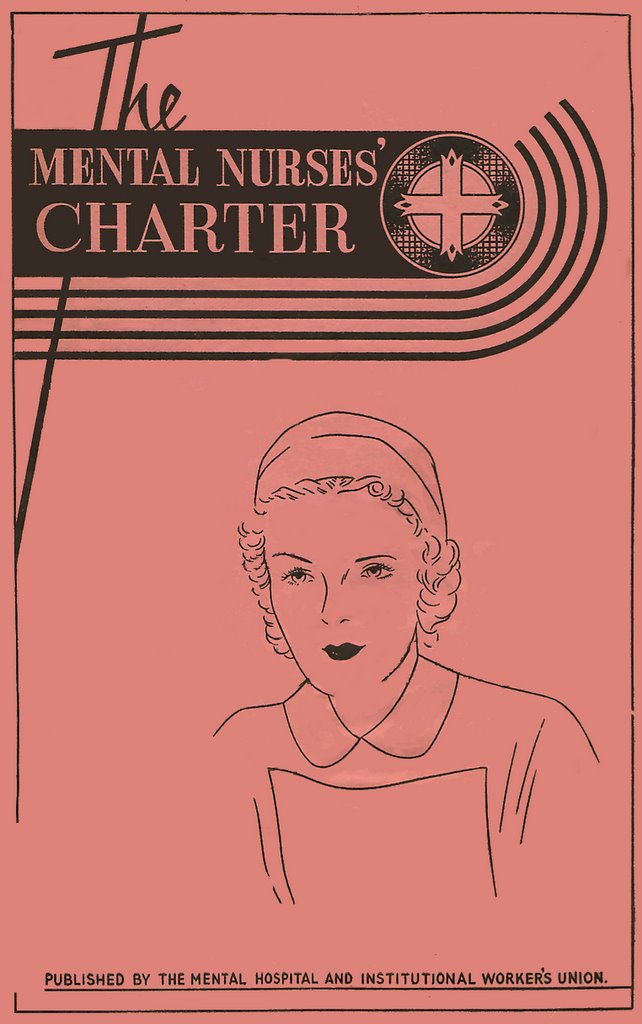
Mental Nurses Charter (1945)


FOREWORD.

Owing to the acute shortage of nurses and the dearth of recruits to the Nursing Service, the General Secretary of the Mental Hospital and Institutional Workers' Union, as a member of the T.U.C. General Council, presented to the Trades Union Congress (1937) the Nurses' Charter, which focused public attention on the necessity of improving salaries and conditions of service in the Nursing Profession.

The Government set' up an Inter-Departmental Committee under the Chairmanship of Lord Alness,

"To inquire into the arrangements at present in operation in Scotland with regard to the recruitment and terms and conditions of service of persons engaged in nursing the sick, and to report whether-any changes in these arrangements, or other measures, are expedient for the purpose of maintaining an adequate service, both for institutional and for domiciliary nursing."

This Committee issued a report to the Department of Health for Scotland on September 29th, 1938, Many hospital authorities failed to give effect to the recommendations of this Committee and the shortage of nurses became more acute.

In October, 1941, the Right Hon. Thomas Johnston, M.P., Secretary of State for Scotland, decided to set up a Nurses' Salaries Committee in Scotland under the Chairmanship of Professor T. M. Taylor :

"To draw up agreed scales of salaries and emoluments for State-registered nurses employed in Scotland in hospitals, including Mental Hospitals."

In November, 1942, it was decided to set up a Sub-Committee in association with the Nurses' Salaries Committee to make a rapid review of the scales of salaries and conditions of service in Mental Hospitals and Institutions in Scotland. This Sub-Committee was comprised of panels of ten members, each drawn from the Employers' Organisation and the Mental Hospital & Institutional Workers Union (MH&IWU). The first meeting of the Sub-Committee was held on January 22nd, 1943 ; the final meeting on September 2nd, 1943.

The salaries and conditions of service agreed by this Sub-Committee were accepted as the terms of employment under the Mental Nurses (Employment and Offences) Order (Scotland), 1943, on the understanding that another Sub-Committee of the Scottish Nurses' Salaries Committee would be set up to deal with many aspects of terms and conditions of service which had not been previously dealt with.

The Secretary of State for Scotland decided that a new Sub-Committee
should be set up

"To draw up agreed scales of salaries and conditions of service of nurses in Mental Hospitals and Mental Deficiency Institutions in the light of the recommendations made by the Taylor Committee."

The Sub-Committee consisted of 12 members on each of two panels representing employers and employees, and their first meeting was held on January 14th, 1944, and the last meeting was held on June 14th, 1945.

Throughout the proceedings of the Sub-Committee the following Union representatives attended meetings :—

Mr; GEO. GIBSON (Gen. Sec.) Mr. J. BUTLER (N.E.C.)
Mr. H. SHAW (Assist. Gen. Sec.) Mr. T. PRENTICE (Scot. Fed. Sec.)
Mr. J. T. WAITE (Nat.
Organiser) Mr. J. RUSSELL (Cupar Branch)
Mr. M. MCBRIDE (Scot. Organiser} Miss A. M. HOWIE (Woodilee B.)

This publication is not a full report of the Sub-Committee's decisions, although the main features of the recommendations are given in detail for the guidance of all Mental Nurses in Scotland.

Saturday, September 23, 2006

Pete Marshall


Pete Marshall started his nursing career at St Margaret’s hospital in Birmingham which cared for mentally handicapped patients/clients.

He was a keen advocate of progressive policies with regard to the mentally handicapped. He soon became involved in the local COHSE branch becoming its Assistant Branch Secretary and publicity officer.

Pete, along with his close friend Andy Stackhouse organised a very high profile campaign regarding staffing levels at the hospital, which culminated in a huge vote of no confidence in the hospitals senior management.

Pete Marshall was appointed COHSE regional officer for North Thames & Oxford region of COHSE in May 1984, securing a high level of popularity amongst the COHSE activists on his patch.

He soon secured a high profile in the London media, around campaign such as Brent anti cuts campaign. Neasden hospital occupation and the 1988 nurses dispute (the later securing not only a significant pay rise for nurses but also a massive increase in London Weighting). Pete helped establish the London Co-ordinating commitee of COHSE and served for many years as London Health Emergency treasurer.

In the mid 1980's, Pete along with Bob Abberley were key in pushing through a mayor review of COHSE’s policies with regard to the Mentally Handicapped services (Learning difficulties). This led the union into having a progressive view with regard to the closure of the old large Victorian institutions. Without this progressive view COHSE would not only have lost new professionals entering this field, but more importantly could have seriously undermined any move to the community facilities.

Pete was a committed anti racists and fascist and was involved the infamous “Battle of Waterloo” against the BNP at Waterloo station.

Pete was elected to the Executive of the Greater London Labour Party and was a close associate of Jim Fitzpatrick (later MP for Bow & Poplar).

In June 1990 Pete was appointed Regional Secretary for the new COHSE London region, but on appointment stated in typical style that his best job was “renting deck chairs out on Bourenmouth beach”.

After the creation of UNISON in 1993, Pete struggled with the new channels of accountability, famously denouncing the wrong right winger in Labour Briefing earning him a famous but hilarious rebuke from Rodney Bickerstaffe General Secretary.

Pete turned down the opportunity to head up health in the capital and moved into UNISON’s energy sector finally moving back to the West Midlands, close to beloved football club, Birmingham City.

Friday, September 22, 2006

COHSE No Cuts in 1987

COHSE Campaigning in 1987 against the cuts

COHSE Conference 1986 Report

COHSE members are looking to turn 1987 into “No cuts year” with a large –scale centrally directed campaign to defend the Health & Social Services.

That was the message from Chris Hart of Maudsley Branch moving Resolution 55. He said: 'We are asking for a campaign run along similar lines to the political fund.

campaign. 'We want to use the media of all forms. We want videos, leaflets, meetings for members of the public and for health workers.'.

And he urged delegates: 'Take this resolution back to your members, take it to
every region and carry on the campaign.'

He was backed by Jean Winship of Bethlem Royal, who said: 'The public doesn’t'
know the true facts.' And she outlined the savage cuts in staffing, pay and conditions in the hospitals.

The resolution was accepted for the NEC by General Secretary David Williams, who urged: 'Don't vote for the resolution and then forget it. Vote for it and then do something about it.” And he went on: 'Here is a wonderful resolution that can unite us in action in campaign.'

COHSE had given full support to miners in their fight, and it had played an
active role in other workers battles, we have supported every working class struggle there is,' he said. Now COHSE had the opportunity to fight united against the cuts.

The resolution was CARRIED.

Conference also backed a call by Cllr Michael Walker of Hillingdon and District Branch, moving Resolution 56, to support London Health Emergency. LHE, he said, was a model of how to run a campaign. And he told delegates: 'COHSE has played an important role and we are proud of the work we have done.'

Bill Nimmo of Dumfries and Galloway played tribute to LHE, whose fame, he said, had spread far beyond London. 'This group of people have been prepared to highlight what Thatcherism is doing to the Health Service,' he said.

David Williams, for the NEC, promised that COHSE would continue to give its
support to LHE. The resolution was CARRIED.

NOTE:
While the COHSE no cuts campaign meet with mixed success, it undoubtedly increased the national profile of COHSE and possibly contributed to the confidence amongst the more advanced elements of the membership. Leading to the successful strike action by COHSE nurses in 1988. A dispute which rocked the Thatcher government and secured major pay rises for nurses.

Chris Hart became a COHSE Regional Officer but returned to his beloved nursing


National Asylum Workers Union Branches 1911


National Asylum Workers Union Branches 1911 (December 1911)

ASYLUM MEMBERS PERCENTAGE OF WORKFORCE

Abergavenny (Wales) 72 members 64% of staff

Aylesbury 59 members 59% of staff

Banstead 82 members 26% of staff

Beverley 20 members

Bexley 180 members 50% of staff (94% of male staff)

Birmingham 114 members

Bodmin 94 members 52% of staff

Cane Hill 149 members 53% of staff

Cardiff (Wales)101 members 80% of staff (91% of male Staff)

Carmarthen (Wales)34 members 34% of staff

Caterham 121 members 35% of staff

Chester 102 members 81% of staff (90% of male staff)

Claybury 145 members 35% of staff

Colney Hatch 104 members 27% of staff

Cotford 63 members 63% of staff

Darenth 186 members 70% of staff

Devizes 110 members 71% of staff

Durham 44 members 25% of staff

Epsom 279 members 45% of staff

Exminister 138 members 76% of staff

Gloucster 75 members

Hanwell 56 members 19% of staff

Haywards Heath 89 members 68% of staff

Hellingly 117 members 59% of staff (83% of male staff)

Hereford 59 members 62% of staff (96% of male staff)

Hull 60 members 62% of staff (97% of male staff)

Lancaster 245 78% of staff

Leavesden 181 members 52% of staff (78% of male staff)

Littlemore 68 members 50% of staff

Macclesfield 150 members

Maidstone 100 members 50% of staff (93% of male staff)

Menston & Scaleboro 225 members 78% of staff (85% of male staff)

Middlesex 75 members 36% of staff

Morpeth 38 members 31% of staff

Netherne 62 members 33% of staff (70% of male staff)

Newport (Wales) 53 members 83% of staff (100% of male staff)

Norwich 28 members 20% of staff

Prestwich 310 members 86% of staff (92% of male staff)

Rainhill 228 members 75% of staff (86% of male staff)

Storthes Hall 149 members 84% of staff

Wakefield 219 members 71% of staff (88% of male staff)

Warlingham 84 members 62% of staff (89% of male staff0

Winwick 245 members 58% of staff (80% of male staff)

York 150 members 60% of staff

also

Limerick, Ireland membership unknown but affiliated

CENTRAL BRANCH
Fulbourne 31 members 36% of staff
Narboro 18 members
Powick 12 members
Tooting Bec 44 members (63% of male staff