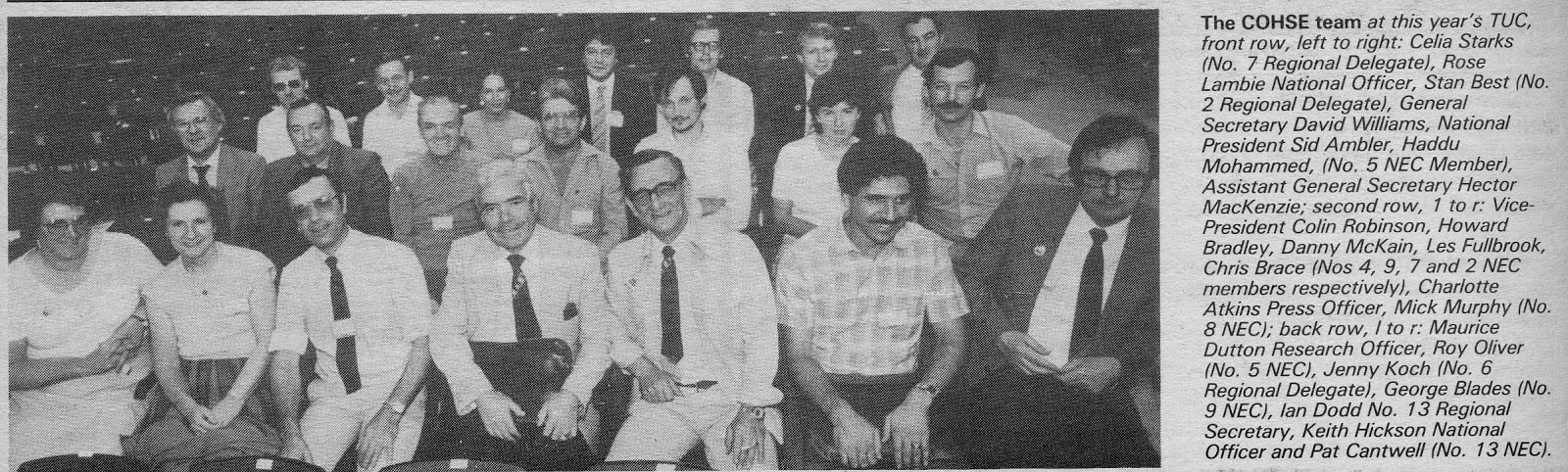
COHSE delegation to TUC 1984 note Chris Brace (behind Sid Ambler) an excellent, well respected and progressive NEC member

Showing posts with label Hector MacKenzie. Show all posts
Showing posts with label Hector MacKenzie. Show all posts
Tuesday, May 24, 2016
Wednesday, October 21, 2015

COHSE Conference 1992

Hector MacKenzie, Mo Mowlan MP, Joan Walley MP (both COHSE sponsored) and some other back bench Labour MP


Sunday, June 14, 2015

COHSE - Joan Walley MP

Joan Walley was a COHSE sponsored MP (Stoke North) - here with Mo Mowlan and a young Tony Blair
With COHSE General Secretary Hector Mackenzie
Scarborough 1992
Friday, May 31, 2013
Hector MacKenzie on the new union 1991

Hector Mackenzie COHSE
December 1991
Changes in health care and in COHSE itself have made it a very different union to the one it once was, says general secretary Hector MacKenzie, who sees the creation of a new union with NUPE and NALGO as the next stage in that development.
From a fairly small organisation concentrated in the 'Cinderella' psychiatric and mental handicap hospitals, COHSE has grown to encompass people working throughout the health care sector.
At the same time, it has become more political, more conscious of the need to reflect the concerns of its over-whelmingly female membership and more anxious to ensure that services are targeted at every union member.
With a sound financial base, the ability to speak directly to members and activists and an enviable range of industrial, professional and political services, COHSE has become an organisation capable of taking proactive decisions, anticipating and shaping developments instead of simply reacting.
It is that ability which led COHSE this year to enter talks
with NUPE and NALGO on the creation of a new public services union.
Over the next few years, the arena in which we organise will change out of all recognition. The shift from hospital to community care is already breaking up the large institutions. Divisions between the NHS, social services, the voluntary and the private sectors are blurring.
National pay bargaining is gradually being devolved. And the demands placed on unions by a changing workforce are shifting in emphasis as large numbers of women re-enter the workforce and part-time jobs increase.
All of this demands an imaginative response. We need a new union capable of encompassing all those working in the public services and of responding to their disparate needs, quickly, efficiently and without bureaucratic delay.
We envisage a union in which the basic local building block, the branch, can be tailored to meet the specific needs of a workplace as small as a group home and as large as a district general hospital.
This means abandoning some of our 'hallowed' institutions, such as the compulsory monthly branch meeting,in favour of a less formal organisation which-recognises that diversity of needs and revolves around a workplace 'patch' with union representatives responsible to the branch for their own patch.
We see regions developing a new facilitating role as
both a resource and an administrative centre, but making sure there is no bureaucratic block in the union decision-making structure.
There should be a national tier of perhaps four key
groups, of which health and personal social services
would be one, with their own autonomous policy-making powers and the ability to direct their own finances. There should be professional advisory panels and consultative conferences for groups such as nurses, ambulance personnel and social workers, and new ways of developing policies through working parties and even ballots.
We also want to see a top tier encompassing all mem-
bers and providing central services, holding the membership register and with overall responsibility for the finances and resources of the union.
Having seen other unions grow large and get things wrong, we should learn from their mistakes. We mustavoid an overwhelming bureaucracy in which no decisions can ever be made and initiative is stifled. We must avoid competing power blocks in which regions and trade groups struggle for supremacy to the detriment of the whole union. And we must avoid simply lumping in all the old practices and structures of all three unions.
In short, there cannot and must not simply be a larger version of COHSE, NUPE or NALGO; we need a new union.
Saturday, December 26, 2009
COHSE Banner's 1991
 Robert Quick, Regional Secretary with COHSE banner of South Yorkshire and East midlands Region 12, Made by Red Wedge, Brighton Red and Gold
Sharrow Head, Sheffield.
 COHSE Banner Cymru Region 10 - Wales made by Dragon Banners Yorkshire. COHSE banner Unveiled by Hector MacKenzie COHSE General secretary Cardiff 1991.
Claybury branch banner is one of the finest COHSE branch banners, as it illustrates a rat leaving the "Asylum".
Wednesday, April 26, 2006
7,000 march in Sheffield (1973)
7,000 Ancillary Workers March in
By Hector Mackenzie COHSE No. 2 Regional Secretary
On 16 March the Yorkshire Co-ordinating Committee decided that it was time to carry the battle for justice for ancillary members a stage further - to the streets of the major cities. The time was felt to be opportune because of the increasing number of messages of support from trade unionists out-side the Health Service and the anticipated support from the Sheffield Trades and Labour Council. It was time the public got the message,
To support the planned demonstration march and rally it was decided that there
should be a twenty-four-hour stoppage of work at all hospitals in
The subsequent demonstration on 23 March turned out to be one of the largest ever seen in the city of
Confederation members from
The marchers left the assembly point at the Wicker Goods Yard in
on the steps outside. Terry Mallinson, COHSE National Officer addressed demonstrators, along with Alan Fisher on NUPE and officers of the other ASC
unions. Speeches of support were made by officers and branch officers of many other unions, too.
The following day saw demonstrators taking to the streets of
The rally after the
The weather was kind to the demonstrators at
For people who are not traditional marchers, our members certainly made their
presence felt and the forest of banners placards and posters made an impressive
sight in all these cities. Leaflets setting out the ancillary staffs case were handed out to the public and the demonstrations were a triumph for organisers and marchers alike.
Subscribe to:
Posts (Atom)