Saturday, July 15, 2006

Spanish Civil War 1937

Labour and Spain.

NATIONAL CAMPAIGN OF DEMONSTRATIONS 1937

"Freedom, Food and Justice—End Fascist Intervention in Spain," is the slogan of a special Campaign of Mass Demonstrations planned by the Labour Party's Spain Campaign Committee.

The central purposes of the campaign are to demand the withdrawal of foreign troops from Spain and the restoration to the Spanish Government' of its freedom

to buy arms, and to assist in relieving the acute food shortage and the distress which afflicts vast numbers of Spanish refugees.

Demonstrations will be held in Manchester, Newcastle, Bristol, South Wales, Leeds, Birmingham and Edinburgh.

In addition a large number of local meetings will be organised at which national speakers will take part.

The campaign will be conducted on a large scale and with intensive effort, and will conclude with- a great central demonstration in London to be held in the Albert Hall on 19th December 1937. The list of speakers will be Mr. George Dallas (Chairman of the National Executive) in the Chair, Mr. Clem. R. Attlee, M.P., Leader of the Labour Party, Sir Stafford Cripps, M.P., Mr. Herbert Morrison, M.P., Mr. Ernest Bevin, Mrs. Barbara Ayrton Gould, and Miss Ellen Wilkinson, M.P.

Mental Health & Institutional Workers Union Journal September 1937

MH&IWU Conference 1937

Resolution on Spanish Civil War

"That this Annual Conference expresses its abhorrence of the continued participation by organised units of the Fascist and Nazi Forces in the Spanish Civil War on the side of the Spanish Rebels; expresses its horror at the indiscriminate bombing and shelling of open villages and towns, as a consequence of which women and children are being slaughtered in the holocaust of war, and demands that the Government shall bring this matter to the notice of the League of Nations with a view to organised intervention [on behalf of the legitimate Spanish Government."

George Gibson General Secretary :In moving this resolution I do not propose to discuss the merits or demerits of the various forms of Government in Spain, or of the differences existing in regard to the question. What I want to do is to express what I think is the Union's unanimous view and the view of every decent- minded person in this country (the opinions of the other type of person are not of much value), that it is a horrible thing that the organised intervention of Fascist countries in the internal affairs of Spain has resulted in the indiscriminate slaughter of innocent women and children.

War, of necessity, is a terrible thing and must, and always will, involve cruel suffering on the part of tile people, but when the modern weapons of destruction are deliberately used against non-combatants, as they were at Guernica and Almeria, it is time for decent people to express their disgust at this method of trying to terrorise one's opponents ; and, whatever be the merits or demerits of the Spanish conflict, it is an undeniable fact that the Government of Spain was the duly elected Government of the people and that those who took up arms against it are, in tact, rebels, whether they have titles, honours, or military distinctions attached to their names. Now, all of us, I believe, wish to see the Spanish Government victorious.

Some may differ on certain aspects of the conflict, but I ask you, whatever your differences may be on this matter, to support the resolution.

Mr. Scovell, (Whitecroft) : I second the resolution and would point out that the fight which the Spanish Government and people are putting up for the maintenance of democratic rule is as much our battle as theirs.

Mr Bond (Springfield, Tooting, London) : We welcome this resolution. Too long has the Spanish Government been left unprotected. The so-called "non-intervention" has, in practice, allowed the Fascist armies to invade Spain. The rebels have been supplied with bombers, machine-guns and war material of all kinds.

The same sort of thing happened in the trouble between China and Japan and, if it is not checked, this Fascist intervention in other countries' affairs will cause war to sweep across Europe like a prairie fire. I believe the same brand of Fascism could come into England. Fascism is not a foreign thing, it is the same all over the world. It now seeks to overthrow the constitutionally elected Government of Spain ; and I will go so far as to say that, if there were a Labour or Socialist Government in this country, determined to carry out its stated programme, Capitalism would not hesitate to resort to Fascism to oust it. I am pleased to see that the National Council of Labour has at last urged action and, believe me, action is needed. Meetings of protest should be held all over the country, in the halls and in the streets, to force the Government to abandon its present one-sided policy of non-intervention, and to restore to the Spanish Republican Government its legal right to buy arms abroad.

Mr Hallinson(St. Bernard's, Southall) : I ask you to accept as an addendum to the resolution after the word " Intervention" in the last line: " On behalf of the legitimate Spanish Government." —(Agreed). It is time our movement became more active in its support of the Spanish Republican Government. I looked through the June issue of our Journal and never a word was said about the Spanish situation, the outcome of which is of such vital importance to peace-loving people. More should be written in the Union Journal about it to create interest among our members and to enlist their support for our comrades fighting the battle of democracy in Spain.

The Resolution was Carried Unanimously.

Mental Health & Institutional Workers Union August 1937

MHIWU later became COHSE and in 1993 Unison

Friday, July 14, 2006

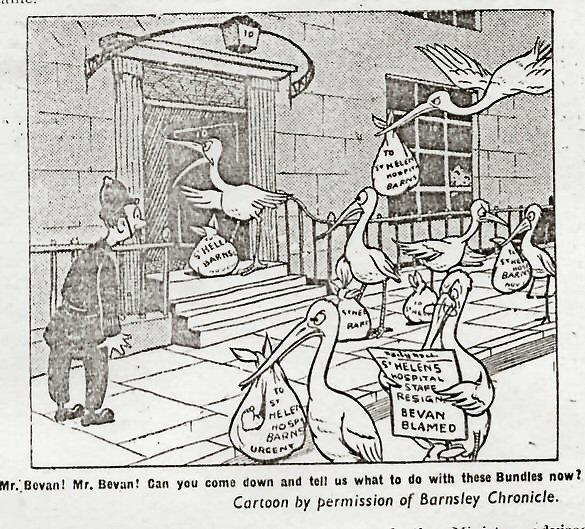
Barnsley Midwives strike 1948


Barnsley Midwives strike 1948

About a year ago (1947) Yorkshire newspaper printed a glowing tribute to Matron M.G. Burn and members of the staff at St Helen’s Hospital, Barnsley, who volunteered to go into quarantine, which lasted three weeks, following an outbreak of small pox. Matron, nurses and domestics worked long hours under trying conditions forgetting self interest to serve the community, knowing that others who refused to accept quarantine would receive wages just the same.

In November, 1947, application was made to the Barnsley Authority for some tangible recognition of their service and it took them, three months to reach a decision to grant them an extra week's pay.

In refusing this, our Barnsley branch 'pointed out that assistant nurses would receive less than £1, while administrative and technical staff would yet over £7

In May the COHSE branch was notified that the Authority adhered to its decision, but after hearing a deputation the following month they agreed to COHSE’s proposal that each member of the staff should receive a minimum of £5 or one weeks wages whichever was the greater.

Then the real trouble began. The Minister refused sanctions to extra loan required to implement the award.

On September 23rd Barnsley branch decided to hand in notices terminating employment. By 27th September, the COHSE Regional secretary W. J Jepson had met various officers, the matter was at regional Board level and the Minister advised of the Barnsley nursing staff’s decision.

On October 1st the nursing staff handed in notices (including the Matron, who was not personally affected) to terminate on October 31st. The domestic staff hand in notices on October 24th to terminate on the same date. This matter which had been dealt with in anything but a satisfactory and efficient manner by the employing authority, had now been brought speedily to hand, and by October 7th an agreement had been reached whereby the Minister authorised payment of the £5 or one week's wages, whichever was the greater, the branch thus scoring a success which at one time seemed nearly impossible.

Why was the Confederation able to persuade the authority to change their mind after two previous decisions ? Why was the Minister made to change his mind after giving an adverse decision a short time before.?

It was brought about by one means only, and that was that the Barnsley St Helen Hospital members were 100 per cent in support of the application made by the branch and were prepared to leave their employment for the sake of a principle they felt to be at stake.

That principle was that equal work and responsibility should have equal recognition. My members of the Barnsley Branch would like to convey to all members of the nursing and domestic staff at St. Helen Hospital who were not affected by this payment their sincere thanks for the splendid way in which they allied in support of the members of the Confederation, and the decision which has been achieved in Barnsley speaks volumes for the conviction, interest and general recognition of the responsibility of membership of the Confederation by our Barnsley people.


COHSE Journal 1948

200th COHSE Member 1977

The 200,000th COHSE Member

22nd February 1977

The Confederation's (COHSE) membership has, as you know, been increasing rapidly in recent times and this has been entirely due to the increasing efforts of our full time officers in the regions, and our active branch officials and stewards. I am very pleased to be able to tell you that our membership has now reached the magnificent total of 200,000, more or less on schedule for the target which I set on becoming General Secretary.

The announcement will be made tomorrow (Wednesday) in London at a press conference and a press release has already been sent to all provincial dally newspapers. A special supplement of (COHSE Journal) Health Services has been prepared and will be available with the March 1977 issue. Special announcements will also appear in the health journals and Labour Movement newspapers of the week ending Friday 11th march

Our 200,000th member is Wendy Ann Thompson, aged 22, a staff nurse at North Manchester General Hospital who joined the union because she "saw how effective we were and is very impressed by the friendliness and professional aspects”

This is a magnificent achievement for the Confederation and means that we have increased in size three-fold in ten years, and doubled in the last five years On behalf of the President and National Executive Committee, I would like to thank everybody in the branches to whom the main credit for this achievement must go.

The NEC Will Insider a new membership target in the future, but in the meantime it is important that all branches should make maximum publicity at local level out of this achievement which of itself will prove to be a valuable recruiting aid

EAG Spanswick

COHSE General Secretary.

COHSE Medical Services Guild

COHSE Medical Services Guild.

BREAKING DOWN CLASS BARRIERS IN DRIVE FOR 100% TRADES UNIONISM


The Medical Services Guild is rapidly becoming one of the most virile sections within the Confederation of Health Service Employees (COHSE)

At long last, doctors, hospital technicians, and other specialist grades are realising that Olympian aloofness is no match for Trade Union solidarity in gaining long-overdue improvements in salaries and conditions of service, with tile result that there is a steady stream of recruits—doctors, dentists, pharmacists, radiologists, etc.—towards the goal of ONE organisation of ALL Health Workers to meet the changes of the coming National Health Service.

Highly successful open meetings have been held recently in London, and Miss L. Mitchell, the Guild's Hon. Secretary, 123 Brownlow Road, New Southgate, London, has been inundated with inquiries.

At the first of these over which Dr. Jeger, (Member of Parliament), the COHSE Guild's London Regional Chairman, presided, Dr. Charles Brook, leader of the Labour Group on the Kent County Council, stressed that the Guild in no way conflicted with the strictly professional bodies like the B.M.A., or the B.D.A., etc., in which Guild members should still retain their membership.

When he was a member of the L.C.C., he had seen many examples of the professional bodies putting cases very badly in contrast with our own Organisation, and C.O.H.S.E., with its well-established machinery and competent officers in every region, could meet the needs of all Health Workers employed in
the new Health Service.

The proposed Regional Boards were bound to give decisions from time to time affecting all sections, which made the need for a united body all the more essential.

Dr. Charles Brook stressed there was full democratic control in our Organisation, and said in the "teething stage" of the new Health Centres there were bound to be problems which could lie examined by each section or guild and by the Organisation as a whole.

Under the wise guidance of the General Secretary and the Union officials, the Medical Services Guild would prove in-valuable to those employed in the new Health Service. Any member would have the full support and backing of a large and powerful organisation.

This aspect was also touched upon by Dr. Jeger, who said that C.O.H.S.E. knew no class distinction. The only concession to the various sections was to organise them in their own particular Guild in order that special matters relating to the individual sections could be thoroughly discussed.

The aim of the Confederation was to raise the standard of service, and to see to it that everybody employed in the Service worked under ideal conditions.

Other speakers emphasised that technical staffs had been less successful than other Health Workers in securing improvements because they had not been so well organised.

Mr. Kirby, a radiographer, said they had only to look at the new wage scales to see what a mess the professional bodies had made.

"The medical ancillary services," he added, "used to think the professional bodies would do all that was necessary for them, but if we are to conduct negotiations with the Health Minister and other bodies concerned, our organisation within the Confederation is essential."

As a pharmacist of 20 years' standing, Miss Mitchell said special departments in the hospitals had developed enormously, and although they were staffed by officers with the highest qualifications, pay and conditions left much to be desired.

The Minister of Health had said that if the Services concerned were better organised they could speak with a stronger voice. By affiliation to the T.U.C. the Confederation had the weight of organised workers in support. Already in the Voluntary Hospital Service better conditions prevailed due to organised effort. Members of all grades had got together as never before. This was growing and should continue to do so. In closing, Miss Mitchell urged full co-operation to meet the changes about to take place in the Health Service.


Replying to a questioner, who said ancillary services had not obtained as many concessions as other grades, Miss Mitchell stressed that when wage rates were under discussion employing bodies knew that professional organisations would be easier to deal with and, therefore, the Trade Union representatives were not invited, with results which are now apparent.

Another questioner asked if there was adequate representation of the various sections within tile Confederation Dr Brook, in reply, outlined the Organisation within the Regions and stated that where Advisory Committees to the various Guilds were established, the endeavor was always to make such Committees widely representative of the various grades within the Guild.

Dr. Richard Doll urged that C.O.H.S.E. should consider giving financial aid to Health Workers who sought to qualify for higher posts by part-time study.

Other replies stressed that there was no discrimination against members who "contracted-out" from the affiliation fee to the Labour Party, and to one questioner who suggested that Labour Party affiliation was a handicap in fighting Labour-controlled authority. Dr. Brook said from his own experience the two original bodies of C.O.H.S.E., the old Mental Health & Intuitional Workers Union and National Union County Officers, had always been the strongest fighters on behalf of their members, no matter which party controlled the authority.,-


Feb 1947

COHSE Medical Services Guild


COHSE Medical Services Guild.

BREAKING DOWN CLASS BARRIERS IN DRIVE FOR 100% TRADES UNIONISM


The Medical Services Guild is rapidly becoming one of the most virile sections within the Confederation of Health Service Employees (COHSE)

At long last, doctors, hospital technicians, and other specialist grades are realising that Olympian aloofness is no match for Trade Union solidarity in gaining long-overdue improvements in salaries and conditions of service, with tile result that there is a steady stream of recruits—doctors, dentists, pharmacists, radiologists, etc.—towards the goal of ONE organisation of ALL Health Workers to meet the changes of the coming National Health Service.

Highly successful open meetings have been held recently in London, and Miss L. Mitchell, the Guild's Hon. Secretary, 123 Brownlow Road, New Southgate, London, has been inundated with inquiries.

At the first of these over which Dr. Jeger, (Member of Parliament), the COHSE Guild's London Regional Chairman, presided, Dr. Charles Brook, leader of the Labour Group on the Kent County Council, stressed that the Guild in no way conflicted with the strictly professional bodies like the B.M.A., or the B.D.A., etc., in which Guild members should still retain their membership.

When he was a member of the L.C.C., he had seen many examples of the professional bodies putting cases very badly in contrast with our own Organisation, and C.O.H.S.E., with its well-established machinery and competent officers in every region, could meet the needs of all Health Workers employed in
the new Health Service.

The proposed Regional Boards were bound to give decisions from time to time affecting all sections, which made the need for a united body all the more essential.

Dr. Charles Brook stressed there was full democratic control in our Organisation, and said in the "teething stage" of the new Health Centres there were bound to be problems which could lie examined by each section or guild and by the Organisation as a whole.

Under the wise guidance of the General Secretary and the Union officials, the Medical Services Guild would prove in-valuable to those employed in the new Health Service. Any member would have the full support and backing of a large and powerful organisation.

This aspect was also touched upon by Dr. Jeger, who said that C.O.H.S.E. knew no class distinction. The only concession to the various sections was to organise them in their own particular Guild in order that special matters relating to the individual sections could be thoroughly discussed.

The aim of the Confederation was to raise the standard of service, and to see to it that everybody employed in the Service worked under ideal conditions.

Other speakers emphasised that technical staffs had been less successful than other Health Workers in securing improvements because they had not been so well organised.

Mr. Kirby, a radiographer, said they had only to look at the new wage scales to see what a mess the professional bodies had made.

"The medical ancillary services," he added, "used to think the professional bodies would do all that was necessary for them, but if we are to conduct negotiations with the Health Minister and other bodies concerned, our organisation within the Confederation is essential."

As a pharmacist of 20 years' standing, Miss Mitchell said special departments in the hospitals had developed enormously, and although they were staffed by officers with the highest qualifications, pay and conditions left much to be desired.

The Minister of Health had said that if the Services concerned were better organised they could speak with a stronger voice. By affiliation to the T.U.C. the Confederation had the weight of organised workers in support. Already in the Voluntary Hospital Service better conditions prevailed due to organised effort. Members of all grades had got together as never before. This was growing and should continue to do so. In closing, Miss Mitchell urged full co-operation to meet the changes about to take place in the Health Service.


Replying to a questioner, who said ancillary services had not obtained as many concessions as other grades, Miss Mitchell stressed that when wage rates were under discussion employing bodies knew that professional organisations would be easier to deal with and, therefore, the Trade Union representatives were not invited, with results which are now apparent.

Another questioner asked if there was adequate representation of the various sections within tile Confederation Dr Brook, in reply, outlined the Organisation within the Regions and stated that where Advisory Committees to the various Guilds were established, the endeavor was always to make such Committees widely representative of the various grades within the Guild.

Dr. Richard Doll urged that C.O.H.S.E. should consider giving financial aid to Health Workers who sought to qualify for higher posts by part-time study.

Other replies stressed that there was no discrimination against members who "contracted-out" from the affiliation fee to the Labour Party, and to one questioner who suggested that Labour Party affiliation was a handicap in fighting Labour-controlled authority. Dr. Brook said from his own experience the two original bodies of C.O.H.S.E., the old Mental Health & Intuitional Workers Union and National Union County Officers, had always been the strongest fighters on behalf of their members, no matter which party controlled the authority.,-


Feb 1947

Cane Hill Hospital Sit-In 18-21 August 1976

Cane Hill Hospital Sit-In 18-21 August 1976

An allocation of ten additional nurses for each day of militantc action — that's the balance sheet COHSE members at Cane Hill are making of their four days of struggle.

Steps are also being taken to fill vacant posts for unqualified staff, and action is now being considered on an area or regional basis to deal with massive under-staffing.

From 18 to 21 August 1976, staff at the psychiatric hospital in Coulsdon. Surrey, provided emergency service only. With laundry and linen rooms shut, no domestic services, and no
occupational or industrial therapy, many staff were in effect sitting-in.

Care of patients was restricted to their basic physical needs, with atotal ban on new admissions. Drivers were available for emergency duties only.

After at first refusing to even discuss Cane Hill's chronic under- staffing, Bromley Area Health Authoruty eventual offer of more nurses for the hospital was forced up to 40 at a meeting on 21 August. When this was put to a mass meeting of staff, there was a narrow majority in favour of calling off the industrial action.

'We would have backed a strike all the way,' says COHSE branch chairperson Glynne John.

'We want two hundred more nursing staff across the psychiatric division, and if the discussions the AHA has now agreed to hold do not result in a big improvement, we will seriously consider further action.

'The staffing situation in the whole of the area and region is scandalous,'Glynne adds, 'and we are now looking to action at this level.'

Neighbouring Surrey AHA. appealed last March for £2,250,000 for desperately needed psychiatric staff. Instead, its budget has been cut by £2 millions.

Advertisements have already been placed for Cane Hill's 40 nurses, who will increase the complement to 610. The four days' action also resulted in: full information on staffing establishment and costs; prior agreement before staff are moved; proposals for local consultation procedures;and improvements in the pay system.

Other COHSE stewards involved Colin Brown and Roy Brown, and COHSE Regional Secretary Bob Harmes

COHSE Journal picture Morning Star of Mass meeting

Thursday, July 13, 2006

CAMPAIGN FOR A DEMOCRATIC HOSPITAL SERVICE 1966

CAMPAIGN FOR A DEMOCRATIC HOSPITAL SERVICE

189 Kingsdown Avenue
South Croydon
Surrey

May 1966

SPONSORS:

NORMAN ATKINSON, M.P, MRS. JOYCE BUTLER, M.P, EDWIN PURNESS, G.L.C. (R.A.C.S. POLITICAL PURPOSES COM.), W. J. JEPSON (C.O.H.S.E.), ALFRED LOMAS (L.C.S. POLITICAL COMMITTEE), SIR FRED MESSER, C.B.E., J.P, W. J. OWEN, M.P, L. A. PAVITT, M.P, DONALD STORER, S.C.C. (S.S.C.S. PARTY)

Dear Friend,

There are many people in the Labour Movement who believe that the present system of appointments to Regional Hospital Boards and Management Committees is undemocratic and that the Hospital Service suffers thereby. The Labour Party Conference passed a resolution last October expressing concern at the completely inadequate trade union and co-operative representation on boards of nationalised industries, regional hospital boards, hospital management committees and similar bodies ". The Conference desired the N.E.C. to press the government to remedy this state of affairs.

The members of the above committee consider the only remedy is the implementation of Labour Party policy on this matter contained in the document " National Service for Health ", endorsed at the 1943 Conference. In this document the following words appear " and these authorities (unlike regional organisations during the war) should be democratically elected ". The authorities were Regional authorities to be instituted when a National Health Service was brought into being.

After the National Health Service was established Aneurin Bevan realised the mistake that had been made and in his book " In Place of Fear " says " Election is a better principle than selection ".

We would like to suggest that you consider sending a resolution for the coming Annual Labour Party Conference requesting the Labour Government to introduce legislation to secure democratic election of Hospital Management Committees and Regional Hospital Boards.

If you support the principle, would you kindly indicate this on the attached form and, of course, as money is required to publicise the arguments, we would be grateful for any donations.

Yours sincerely,

ERIC MESSER.

CAMPAIGN FOR A DEMOCRATIC HOSPITAL SERVICE COMMITTEE:

P. BYRNE, R. W BYRON, MRS.D. GOATLEY, R. JONES, SIR FRED MESSER, F. A. (ERIC) MESSER, S. SHAH, D. STORER, G. WALLIS

COHSE NURSES' PAY CAMPAIGN 1962


COHSE NURSES' PAY CAMPAIGN 1962

COHSE Journal May-June 1962

Only Trades Unionism Can Win - Lesson of Trafalgar Square Rally

THE thousands of COHSE nurses who marched in procession from Marble Arch to Trafalgar Square on Saturday, 28April 1962, in Britain's biggest-ever demonstration by hospital staffs struck a blow for trades unionism which may

become historic. They didn't march in masks for fear of victimisation as student nurses did 14 years ago. They acted on Union advice to wear uniforms and not be afraid of being disciplined.

A Paddington matron who ordered one of her students to wear a "penance gown" for parading in uniform very quickly quashed the order when newspapers and M.P.s denounced the punishment as a stupid survival of Victorian days.

Male nurses, many in white coats, made up about half of the total turn-out which included coach loads from as far apart as Bodmin, Cornwall and North Scotland.

More coach loads were in preparation for the Whitley Council Staff Side rally of 7,000 nurses at Albert Hall, London, as this Journal went to press.

A large proportion of the 7,000 new members enrolled since the dispute are women—an indication that the bogy of anti-trades unionism in the general hospitals is being laid.

As the general secretary told the Association of Matrons, "With 40,000 nursing members the confederation now represents well over 50 per cent of organised nurses. The time has arrived when there is need for trade union machinery to represent nurses and not professional bodies appointed for other purposes."

When the marchers reached Trafalgar Square one could see a forest of banners and posters bearing such slogans as "Angels are needled",

"The Lamp is Dim". One depicted a bottle marked "2.5 per cent—NOT TO BE TAKEN", Another showed the same bottle being tilted into a flask with the wording "This is a poor tonic, Enoch." (Enoch Powell Secretary of State for Health)

Vice-President Ron Farmer as chairman had an easy task in controlling a good-humoured audience, and General Secretary Jepson, showing no signs of his strenuous campaign, received a rousing ovation. His hard-hitting speech was followed by equally vigorous one from Mr. Kenneth Robinson, Labour M.P. for St. Pancras North and chairman of the Party's mental health committee. But it was ex-Matron Mary G. Burns (N.E.C.) who roused the student nurses into

roaring "We are". When she asked: "How many of you have still to go to lectures in your off-duty time? Have worked four or five months on night duty? Have been sent away on holiday and had to come back to take an exam?"

Support for the nurses came from hundreds of organisations including the British Medical Association and the T.U.C. Many industrial workers took unofficial strike action in support of the claim and a position was reached when both the T.U.C. through its chairman. Miss Anne Godwin, and the Confederation, through the general secretary issued warnings that unofficial stoppages could become more of a hindrance than a help to the nurses' claim.

One of the first and by far the biggest of the sympathy stoppages was by 37,000 workers at Ford's, Dagenham, when the management retaliated by calling off their own pay talks.

Members responded splendidly to the call to write protest letters to the Prime Minister and the Health Minister—enclosed in black-edged envelopes where possible.

Reports of regional rallies addressed by the general secretary and other officers are on the next two pages.

LONDON

LONDON'S first demonstration at Caxton Hall, Westminster, exceeded all expectations and was an exciting foretaste of what was to follow up and down the country;

Between 3,000 and 4,000 took part, packing-four big rooms and an adjoining ballroom' for speeches by Vice-President Ron Farmer, who presided, the general secretary, Mr. George Brown, M.P., Mrs. Bessie Braddock, M.P., and ex-Matron Mary Burns (N.E.C.).

Note

Also Dockers on strike 28th April, Tanker drivers 26th April and many more in support of the COHSE Nurses campaign

Seperate Mental Nurses Whitley Council Circa 1955

Drive For Separate Mental Nurses Whitley Council

By Joe Soley COHSE Goodmayes Hospital Branch Secretary

COHSE Journal January 1956


CARRYING posters with the slogans " Mental Nurses Demand their own Whitley Council," " Am I only worth 2s. one and half pennies an hour ? ", " £50 increase for Student Nurses." and " Overtime Rates for more than 48 hours," mental nurse members from Nos. 5 and 8 COHSE regions paraded outside the Royal College of Nursing in London on November 19th 1955, while the Nurses and Midwives Whitley Council was in session, in support of our campaign for separate negotiating machinery and a new deal for mental nurses.

That a £15 increase was the most we could extract from the Nurses & Midwives Council should strengthen the resolve of branches in other regions to follow our example, and lose no opportunity of arousing public support for our claims including a shortening of incremental stages for staff nurses and payment for overtime.

Judged on numbers alone—about 40 members joined in the protest parade—it was not such a spectacular demonstration as the student nurses' march to Hyde Park a few years ago—but it won for us considerable publicity in the local and national press, not to mention a great deal of public sympathy.

More than that, it shocked the Royal College out of its Victorian complacency and its startled officials must have got another shock when the hastily summoned police did no more than ask the demonstrators to keep off the pavement, and allowed them to continue their protest parade for another half-hour while the Whitley deliberations continued inside the College buildings.

Among the demonstrators interviewed bv newspaper reporters were Mr. Louis Aarons, Runwell branch chairman, and Miss Gladys Andrews, one of my student nurse members at Goodmayes, who was quoted as saying : "After paying for board and keep, I am left with £2 5s a week. We have to buy our own outdoor uniform. It just isn't enough to live on."

Now that we have broken the ice, I hope other branches in the London area will join in similar demonstrations at future meetings of the N. and M. Council. The time is also ripe for our provincial colleagues to be up and doing, and Iam sure it will not tax their imagination to devise-ways and means of attracting public attention to our grievance.

I hope members will take this up at their branch meetings without delay for it is essential that we should have vigorous "rank and file" support for the uphill fight which your representatives are waging within the N. and M. Council.

Powerful backing can also be gained by lobbying your local M.P.s as many of us have done in the London area;

My own branch asked our M.P. to receive a deputation but even before he could meet us he had asked seven pointed questions in Parliament on the relation between the shortage of mental nurses and the deficiencies of the negotiating machinery. For months we have been pleading with the Minister to restore the mental health negotiation machinery to where it belongs—the mental health service.

Orthodox protests having failed it is up to us to adopt more spectacular methods of awakening the authorities to the dangers of the present Whitley set-up which has reduced our mental hospitals to a state of overcrowding and understaffing bordering on a national scandal.

Branches get busy.

Joe Soleys son is Clive Soley MP

Seperate Mental Nurses Whitley Council Circa 1955

Drive For Separate Mental Nurses Whitley Council

By Joe Soley COHSE Goodmayes Hospital Branch Secretary

COHSE Journal January 1956


CARRYING posters with the slogans " Mental Nurses Demand their own Whitley Council," " Am I only worth 2s. one and half pennies an hour ? ", " £50 increase for Student Nurses." and " Overtime Rates for more than 48 hours," mental nurse members from Nos. 5 and 8 COHSE regions paraded outside the Royal College of Nursing in London on November 19th 1955, while the Nurses and Midwives Whitley Council was in session, in support of our campaign for separate negotiating machinery and a new deal for mental nurses.

That a £15 increase was the most we could extract from the Nurses & Midwives Council should strengthen the resolve of branches in other regions to follow our example, and lose no opportunity of arousing public support for our claims including a shortening of incremental stages for staff nurses and payment for overtime.

Judged on numbers alone—about 40 members joined in the protest parade—it was not such a spectacular demonstration as the student nurses' march to Hyde Park a few years ago—but it won for us considerable publicity in the local and national press, not to mention a great deal of public sympathy.

More than that, it shocked the Royal College out of its Victorian complacency and its startled officials must have got another shock when the hastily summoned police did no more than ask the demonstrators to keep off the pavement, and allowed them to continue their protest parade for another half-hour while the Whitley deliberations continued inside the College buildings.

Among the demonstrators interviewed bv newspaper reporters were Mr. Louis Aarons, Runwell branch chairman, and Miss Gladys Andrews, one of my student nurse members at Goodmayes, who was quoted as saying : "After paying for board and keep, I am left with £2 5s a week. We have to buy our own outdoor uniform. It just isn't enough to live on."

Now that we have broken the ice, I hope other branches in the London area will join in similar demonstrations at future meetings of the N. and M. Council. The time is also ripe for our provincial colleagues to be up and doing, and Iam sure it will not tax their imagination to devise-ways and means of attracting public attention to our grievance.

I hope members will take this up at their branch meetings without delay for it is essential that we should have vigorous "rank and file" support for the uphill fight which your representatives are waging within the N. and M. Council.

Powerful backing can also be gained by lobbying your local M.P.s as many of us have done in the London area;

My own branch asked our M.P. to receive a deputation but even before he could meet us he had asked seven pointed questions in Parliament on the relation between the shortage of mental nurses and the deficiencies of the negotiating machinery. For months we have been pleading with the Minister to restore the mental health negotiation machinery to where it belongs—the mental health service.

Orthodox protests having failed it is up to us to adopt more spectacular methods of awakening the authorities to the dangers of the present Whitley set-up which has reduced our mental hospitals to a state of overcrowding and understaffing bordering on a national scandal.

Branches get busy.

Joe Soleys son is Clive Soley MP

Wednesday, July 12, 2006

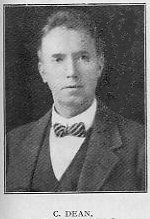
Charlie Dean - Whittingham Pioneer


Death of a Whittingham NAWU Pioneer Charlie Dean - Died 1937

It is with the deepest regret that we record the sudden and unexpected passing of the late Charles H. Dean, former President of the Whittingham Branch, late member of the National Asylum workers Union National Executive Committee and a Trustee of the Union, on February 15th, 1937 at the age of sixty-three years.

Evidence of the esteem and affection in which " Charlie Dean " was held in the district was provided at the funeral which took place on February I8th 1937 at St. Mary's, Goosnargh when a large congregation took part in the service conducted by the Rev. B. Boss.

A large number of male wises in uniform also attended, of whom R.Fazackerly, A. Dumbleton, . F. C..Robinson D. Williams, J. Watson, B. Fare, D. McKenzie, and A Little acted as bearers,

The representatives present on behalf of the MHIWU Nursing Sub-officers were Messrs, W. Foden. T. Hall and R. Cunnington: The Whittingham Branch was represented by Messrs D C Williams (Secretary), J. Woodcock, M. Mercer and G. Oxborrow; Mr Woodcock also represented the Lancashire, .Cheshire and North Wales Federation.

The local nursing association was represented by, Mr, Marshall. Dr. A. . R, Grant (Medical Superintendent) also attended.

Amongst the many; beautiful floral tributes: were wreaths from the Union’s National Executive Council and.-Officers of the union and from members of the; Whittingham Branch

The late Charlie Dean was ‘stalwart of trade unionism' He along with others in the dark and distant past brought into being the organisation we know to-day.

To belong to the Union in those days could easily result in the loss of one s ]ob ; yet men of the calibre of Dean worked hard and courageously in the face of official opposition and largely as a result of their efforts they have given-to us an organization and a record of achievement that stands

J W - Union Journal March 1937


NOTE

Charles Dean was also a candidate for NAWU President at the Seventh Annual conference in July 1921, Birmingham losing to W. Jones 1920-1922

National Asylum Worker Union branch at Whittingham established December 1917

Biggest branch in union in January 1918 with 426 (86% of all staff) "Premier branch" of the union

By March 1918 Whittingham branch had 507 members, including 73 serving with the Colours (Army)

Jim Quick - Chester COHSE

Pioneering nurse Jim Quick will be remembered as a vetran trade unionist and life-long Socialist. He died October 4th 1997

My farther began his working life as a welder at the Camel Laird Shipyards, Birkenhead. He was 30 when the NHS was about to be created and so wanted to be a part of the socialist vision of a-hew society that he applied to train as a psychiatn'c nurse.

Transferring his membership from the boitermakers' union, he became a founding member of the newly formed union COHSE. He soon needed COHSE's support — the superintendent at the Deva, the Chester county mental hospital, attempted to discipline him for refusing to drive a combine harvester on the hospital farm.

But his boldness impressed local union officials and he was elected COHSE branch chair— fairly unusual for a student nurse

He qualified as an RMPA (Royal Medico-Psychological Association) in 1948 and worked in London, Cumbria and Staffordshire before returning to the Deva as a charge nurse in 1957. He resumed his involvement with the union and was elected Chester branch secretary, regional council member and executive member.

My father was promoted to assistant chief male nurse at the Deva and later to nursing officer. He believed that industrial therapy should be the core of patient rehabilitation services and took responsibility for the management of the industrial therapy unit, which he developed as a hub of patient activity at the hospital.

Promotion did not spell the end of his union activities and he continued as secretary of the officers' branch of COHSE until his retirement in 1975, when he moved to a part-time post with the Cheshire Area Health Authority. He was awarded life membership of COHSE in 1981.

As an active member of the Labour party for many years, he was delighted to see Chester elect its first Labour MP on May 1, 1997 this year.

Three of my father's four sons are nurses and Unison (and former COHSE) members. He will be remembered by his family, former comrades and colleagues as a pioneering nurse, a committed trade unionist, a life-long socialist and a passionate defender of the NHS.

Robert Quick is East Midlands associate regional secretary and regional head at health for Unison (now working as Human resources Director)

COHSE historian Mick Carpenter stated

Jim Quick as a charming man and a progressive who sought to take COHSE into the modem era while I remaining true to its principles.

In the 1950s and 60s he embraced the new philosophies of care that took mental health out of the asylum era. He also took a courageous stand on unpopular issues such as racism against nurses from abroad. The present generation of nurses needs to acknowledge the debt they owe to men like Jim.


Nursing Times 22 October 1997

200 Nurses sacked in South Africa 1961

200 African Nurses Told To Leave Union or Be Sacked

September 1961 COHSE: the health care union Journal report


THE South African Congress of Trade Unions reports that 200 nurses at King George V Hospital,
Durban, have been given an ultimatum to resign from the Hospital Workers Union, a non-white body, or be dismissed.

Previously 20 nurses were sacked following a strike and meal boycott by African, Indian and coloured nurses at the hospital, in protest against the caning of nurses and very low wages (an African nurse receives about £12 a month, plus board and lodging; a labourer receives as little as £5 a month).

In the middle of July the Hospital Workers' Union, an affiliate of S.A.C.T.U., submitted a memorandum to the hospital authorities asking for increased wages and improved conditions of work. The demands ranged from £1 to £1 10s. a day increased wages; maternity allowance; unemployment pay; workmen's compensation; infectious disease allowance; 3 weeks' annual leave; improved food; shorter hours of work; recognition of the Union. (The demands varied according to the different categories of employees, staff nurses, maids, nurses, clerical workers, cooks, labourers, and so on.)

African nurses and labourers at the hospital decided to boycott food supplied to them on August 5, after the caning of 11 African nurses by a white sister-tutor because they were "not too bright at classes". The hospital was brought to a standstill when the African nurses marched to the superintendent demanding the expulsion of the sister-tutor and calling on him to investigate their grievances.

They were joined by Coloured and Indian nurses and all the non-white staff : labourers, clerical workers, cooks etc. The demonstration lasted about 8 hours, during which time hundreds of police were called out. the chief of police addressed the workers but was unable to persuade them to return to work.

The superintendent at last arrived, and after a great deal of argument agreed to investigate their grievances. He stated that he was not prepared to negotiate with the Union. The workers then returned to work, but the nurses living in the hospital started a boycott of their food and decided to continue this until their demands are met, food being supplied by sympathisers.

A second demonstration took place 10 days later when some 300 non-white nurses marched to the superintendent's office to demand the transfer of the sister-tutor from the nurses' home. Before this march took place, uniformed police patrolled all wards at the hospital and an armed contingent of police in a riot van was outside the hospital. The superintendent refused to see the nurses, and all the demands of the workers have been rejected on the grounds that they are "politically inspired".

The nurses are continuing the struggle. They ask for protests to be sent to the hospital authorities and for support for their demands, and also for donations. The address of the Hospital Workers' Union is 311 Lakhani Chambers, 2 Saville Street, Durban, South AfricaA. The Union will pass on all protests received.

It Should be noted that during this period the Royal College of Nursing (RCN) maintained links with the Whites only nursing union in South Africa

------------------------------------------------

CANED AFRICAN NURSES PROTEST

Sir—The following is a copy of a letter I sent to the Superintendent of King George V Hospital, Durban, South Africa, on November 16, 1961, after reading an account of events at the hospital in your Journal:

Sir—The P.S.I, is an international federation of trade unions and professional associations of civil servants and public employees, including nurses and other hospital workers. Its affiliated organisations number 75 and 37 countries throughout the Western world. The total membership is 2.4 million.

In the Journal of the British Confederation of Health Service Employees (issue of September/October 1961) I read an amazing and shocking story of the caning of nurses followed by a naturally justified rebellion by well nigh the whole staff of your hospital and by the irruption of the police into the hospital. This appears to be about the ugliest incident that, together with many others, illustrates the thoroughly bad relations between an employing authority and its workers. The relationship appears to be characterised by intimidation against organising in trade unions and the refusal to grant fair conditions of employment.

Words are inadequate to express the indignation that such action arouses in all people who value human rights and human dignity. I know that Apartheid interferes with the normal functioning of civilised life and I can visualise that in some instances employers lack the independence or the courage to resist a damnable policy imposed on them from above.

However, the administrator of a hospital is in a position- that enables him to wield authority and power in accordance with the dictates of conscience, even in opposition to higher authorities whom racial prejudice has made unreasonable.

The incidents of August 5 and 16 last provided copy for an unseemly page in the professional journals of nurses and hospital workers. It is in your power. Sir, to redress a bad situation and to enable the editors of those journals to report on something good and hopeful coming out of South Africa by virtue of your own action. I appeal to you to use your power to that effect.

P. TOFAHRN,

Overseas nurses and Queen's english 1968

COHSE Conference 1968

Queen’s English resolution rejected by delegates

Resolution 125 Hellingly Hospital branch

The Conference, having regard to the difficulties of both patients and staff, agrees that representation be made to limit the employment of non-

English speaking nursing staff (particularly student nurses). Employment of such staff should not exceed, say, 10 per cent in any hospital.


M. A. Taylor (Hellingly): moving

There is no colour bar in this resolution. We have coloured people at Hellingly, we take them into our stride, they are members of my organisation and we welcome them if they can speak the Queen's English. Some of the sisters have to ring round to other wards to get somebody who can speak French and English to interpretate to girls to tell them what to do.

FRENCH AND SPANISH

We have 24 Spanish orderlies, 39 French nursing assistants and 17 French student nurses out of a total staff of 280. What we want is 10%. That is ten in a hundred, 28 not 80.

A. L. Ruler (Maidstone) seconded:

I purchased a paper last night and in this paper was a case of three student nurses from Hellingly Hospital. They were prosecuted for an offence which is nothing to do with us, but the report said they were asked to pay four guineas interpreter's fees. Now I ask you, how on earth can one employ people in a mental hospital with mental patients when they have no idea whatsoever of one word of English?

I WAS FOREIGN"

Mrs. M. L. White (Colchester): I was a foreigner 14 years ago with not a word of English. We had lots of reports in the hospital where I was first working, of' complaints in the newspapers, but the answer one of the Scottish doctors offered I thought was marvellous. She thought we had the most wonderful look because no matter what the patient said, no matter how the patient swore, we were always smiling.


If you are going to review foreign nurses coming into this country, what are you going to put in their place? I hear remarks from the patients themselves: "I like foreign nurses." Not very often you hear that they dislike foreign nurses.

Peter Owusu (Charge nurse at Queen Mary's Hospital, Sidcup, Kent)

I would like to tell delegates that the sentiments which I have heard 'during the Conference from Monday up to the present time will remain in the annals of my life. I will carry back home to Ghana the message that they should not think British people are racialist. They are not, but there is an element of political flavour in this resolution.

POLITICAL ARENA

If the mover of this motion spoke of inadequacy or of those who have not control of the English language I would understand it. Before student nurses are employed they are given a form to fill and their academic qualifications are put in, and English language is one of the prominent things required. We shouldn't allow a political arena to spring out of this thing.

Resolution Lost.

Saturday, May 20, 2006

Maude Wiese

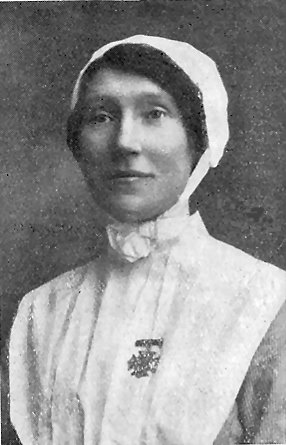
MAUD EVE WIESE

Miss Maud Wiese was the first woman member of the National Asylum Workers Union (NAWU) Executive Council, she was adopted as NAWU candidate in the General Nursing Council elections held after the passing of the 1919 Nurses Registration Act.

She was the first NAWU candidate elected to the GNC in 1922. She was incessant in pressing the interests of mental nurses on the General Nursing Council (now Nursing & Midwifery Council) during the early 1920s.

This earned her many enemies among the entrenched interests dominant in its decision-making structures, especially the College of Nursing.

She retired from the GNC in 1927 active campaigning during the late 1920s, after promotion to head nurse at Claybury Mental Hospital in Woodford Green, Essex. In August 1927 she was appointed Assistant Matron at Bexley Mental Hospital, Kent.

In 1937 she stood again for the GNC again along with Iris Brook and Thora Silverthorne.

Note trainned/exams at Banstead Asylum  Surrey

Probably born Battersea 1890 (1901 census)

Dr William Wiggins NUCO President

Dr William Wiggins MRCS LRCP DPH

An early President of the Poor Law Workers Trade Union (PLWTU) Dr Wiggins was the most prominent doctor in the union's history.

After 1911 he was medical superintendent at Greenwich Infirmary and, in the years following the First World War, threw himself into the movement to establish a union for poor law employees.

He was defeated in the Presidential election, December 1923 by David Priestly (President 1923-1926) a hospital barber from Epsom

Dr Wiggins may have been the most active medical man in the union's history, but other doctors did join and participate.

In the 1930s a Medical Services Guild was established as part of NUCO to cater for their interests, which continued into COHSE.

Friday, May 19, 2006


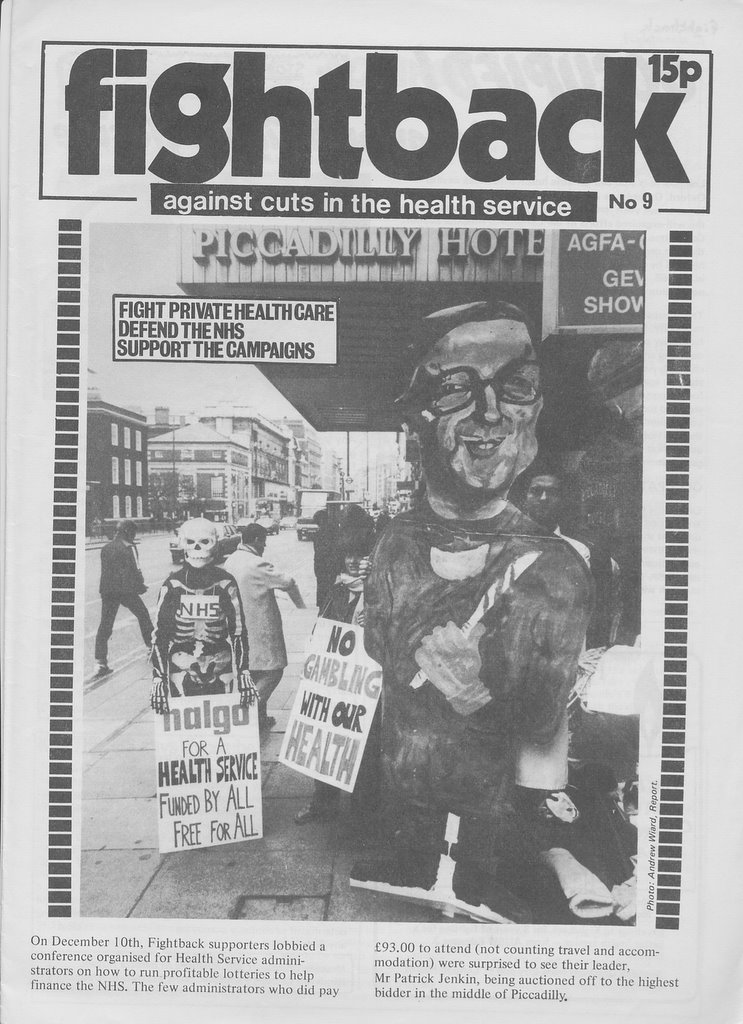
FIGHTBACK

30 Camden Road, London NW1

Campaign Against Private Medicine

As you may know, Fightback is a national campaign which was set up in 1978 by several major anti-cuts campaigns. Our aim is to support and co-ordinate any campaign or trade union action taken against the cuts in the National Health Service and fight for better health for all. Since then we have been involved in most of the hospital work-ins and other anti-cuts campaigns. We are a completely independent organisation made up of affiliated bodies, mainly trade union branches (health, public sector and industrial) and Trades Councils and Cuts Campaigns i'rom all over the country. We produce regular Publications such as our quarterly bulletin and Action Sheets on specific topics. However, in recent months it has become clear that cutbacks in the NHS are directly linked to a massive restructuring of health care services. And although most people are painfully aware of the current underfunding of the NHS, they are less aware of the direct links between this and the rapid growth in private medicine. For this reason, Fightback has decided to throw its resources during the coming months into a major campaign against private medicine and the decline of the NHS.

Is private medicine that important? We think it is. The stated aim of the present Health Minister, Dr Gerard Vaughan, is that 25% of health services should be provided by the private sector. The Financial Times (7.1.1981) calculated that inSeptember 1980, 3.4' million people were covered by private health insurance schemes (this represented a growth of 25% in one year). Other aspects are the abolition of the Health Services Board which has helped to make private hospital building a boom industry; new doctors' contracts which allow more time for private patients; the proposals for a new system of National Insurance coupled with charity schemes and lotteries to raise funds for hospitals and equipment by which people are asked to pay twice for services. But perhaps the most worrying thing is the result of a National Opinion Poll survey on trade unionists' attitudes to private health insurance. This showed that in February 1980, out of a survey of 2,000 trade unionists, 66% said they were in favour of their union accepting a deal on pay which included private health insurance.

Meanwhile, in the NHS there are ever increasing waiting lists, hospital and ward closures, staff shortages and low pay. It is no surprise that many people mistakenly see private medicine and private health insurance as a solution to their own problems. What we see is a dangerous slide towards market-place, profit-motivated health for those that can pay, and an impoverished, charity-backed NHS for those that can't, including the elderly, the chronic sick, mentally ill and physically disabled. We believe this will totally undermine the basis of the NHS as it was set up in 1948.

Our campaign is intended to back up the trade unions' commitment to oppose the existence of private medicine. We are fighting for an efficient, expanded National Health Service, freely available to all at time of need, paid for by general contributions and democratically controlled by those who work in and use it.

To launch the campaign, Fightback is planning to hold a conference in the summer of 1981, and we are producing a pamphlet to be of direct use to trade unionists and the Labour movement in the workplace and in the community. Our last pamphlet, "Keeping Hospitals Open", sold 8,000 copies and was widely circulated especially amongst public sector trade unions and campaigns. We intend this pamphlet to reach an even bigger audience and in particular unions whose members may feel persuaded to join workplace health insurance schemes. We would like to print 10,000 copies at first. This will require a big initial outlay, but the reduced cost for printing this number will allow us to keep the price of the pamphlet low. We hope that this will build up interest and support for the summer conference. In both pamphlet and conference, our emphasis will be on providing the basic facts and arguments, with practical examples from different areas and suggestions for ways of organising effectively.

We are writing to you to ask for your support in this campaign.

WHAT WE ARE ASKING FOR

1. A DONATION — as large as you can make, towards our target of £3,000. (If you wish, this can take the form of a monthly Banker's Order.)

2. SPONSORSHIP. We would like to add your name to our list of sponsors for our pamphlet and/or conference.

3. ADVANCED ORDERS OF THE PAMPHLET (at a reduced rate for sponsoring bodies).

4. For you to CIRCULATE INFORMATION about the Private Medicine campaign amongst your members. (Further copies of this letter available from Fightback.) We will be happy to inform you of all planning meetings for the conference and hope you will be able to send a delegate. We will also be pleased to provide you with any further details or information you require on Fightback and on our proposals. We enclose a reply slip. .

We look forward to your response.

Yours, in solidarity

Kate Truscott, Vicky Hutchin

(for Fightback)

Circa March 1981