Monday, April 24, 2006

1982 Conference M.Star report


1982 Conference Morning Star report

COHSE Conference 1982

Morning Star Report

By JIM ARNISON Bridlington

Overwhelming vote to step NHS fight

DELEGATES attending the COHSE conference here yesterday voted overwhelmingly to escalate the health service pay dispute, but rejected calls

for 'all-out strike action.

The national executive's committee's emergency resolution, calling for a stepping up of the fight for a 12 per cent pay increase, was carried with only

15 of the 600 delegates voting against.

There were however repeated calls in the debate for all - out strike action and Mrs. Thatcher will find no consolation whatever in the more alanced decision of

conference to continue and extend the action already, begun. The union's general secretary, Alert Spanswick, said that the Tory government was on the run

"I believe we have already won the hearts and minds, not only of our members, but also of people of this country."

Never before had there been such an overwhelming chorus of criticism of government policy from the press, from patients and from the public.

"Other working people and their unions have taken your cause to their hearts in the most magnificent display of trade union solidarity it has every been

my privilege to witness," he said. Mr. Spanswick expressed a special thanks "to all the miners, the steel workers, to dockers and the seamen and all those thousand's of other trade union members who joined us on the one-day strikes of June 4 and June 8 and who will be joining us again on June 23."

The executive's resolution calls for the pay campaign to continue with selective withdrawal of key groups of staff, designed to reduce the NHS to, an accident arid emergency service only by the end of June.

It also called for increased support from the (trade union movement, including industrial action by other trade unions and financial and organisational support.

TROOPS THREAT

Mr. Spanswick made it clear that should any members of the union be disciplined (or carrying out official industrial action there would be an all-out with-drawal of labour in the locality concerned. And that should either troops or volunteers be used to break official strike action locally, there would be all-out withdrawal in (he locality concerned. In thedebate.

Mike Murphy, Maidstone, said that selective strikes were ineffective. He said that both members and patients suffered by piecemeal action "let's make It quick, sharp and short. Let's go all out and get it over with."

Andrea Campbell, Hackney, said that after all the selective stoppages had taken place members were no closer now than at the start., "We have got to take all-out strike action. We accept the NEC's resolution, it is going . to be a long hard road and we are not going to get anywhere."

650 HOSPITALS

Bill Dunn, (Ambulance man) Hanwell branch, asked how long the union could hold out in the event of an all-out strike and urged delegates: "Don't play into Mrs. Thatcher's hands. "She would love to go to the Tory conference to say that she had broken the health service unions." He urged delegates to support the NEC resolution.

Mr. Spanswick made it clear that the union was serving notice that industrial action would continue until the government conceded the claim.

There were now about 650 hospitals working on the basis of accident and emergency admissions only, and a further 1,500 hospitals were affected by disruptive action. It was wrong to suggest that the present strategy and tactics would not bring success. "What we have to do now is to extend and develop the actions we are already taking."

Seafarers' pledge

A special mass meeting of South Wales seafarers from

Newport. Cardiff and Barry yesterday promised health workers "any support or action they require during the dispute." The resolution; will be put into action today when seafarers Join the picket join outside St. David's, Sully and Hamadryad Hospitals, and later join striking miners and health workers on a demonstration through the streets of Cardiff.

Industrial Action 1979

COHSE - Glen House, High Street, Banstead, Surrey


To; All COHSE Branches, NEC Members and Officers

11 January 1979

NATIONAL HEALTH SERVICE DISPUTE - SPECIAL NEC MEETING

10 JANUARY 1979

A special meeting of the National Executive Committee was held yesterday

at which detailed consideration was given to the form of industrial action to be taken by COHSE members in furtherance of the dispute in the current pay round for ancillary staff and ambulance staff, and in support of the claim made on behalf of nurses and midwives for special treatment on pay.

The following decisions were taken

Day of Action - 22 January 1979

This action is not intended to be confined to the grades referred to above. Our membership in all disciplines should take part wherever possible in accordance with the previous instructions issued to branches, as it is of vital importance that the demonstration be well supported.

Subsequent industrial action

It was agreed that after the 22nd January there should be continued industrial action on a selective basis organised locally and approved nationally. This action should be co-ordinated at local level to ensure that all trade unions involved are taking the same action.


The forms of action approved by the NEC are as follous;-

Ancillary Staffs

a) Ban on overtime working

b) Laundries: The action recommended to be taken in laundries shoud be - control from within; i.e. a limitation on through putt o be agreed locally. Total closure may be recommended in some cases but essential services must be maintained.

c) CSSD (Sterile Supplies) Again essential services should be maintained and the same principle as laundries apply. Industrial Therapy Departments should be asked to co-operate where they carry out CSSD work

d) Catering: All special catering should cease; i.e. official functions etc.

e)Cleaning Services All -clinical areas should be cleaned – Non clinical areas; i.e. corridors, offices, etc.

f) Post: Only patients' mail and pharmaceutical supplies should be delivered. Official mail should not be sorted or delivered.

g) Transport: This can be left to local discretion, but arrangements must be made for carrying of clinical needs, food, drugs and fuel.

h) Telephonists; Restrictions should be applied. Only emergencies should be dealt with. The same arrangement should apply to bleeps.

i) Porterinq Services: No movement of non-essential materials should take place. Delivery of food, pharmaceutical and sterile supplies is regarded as essential, as is movement of patients. Infected materials should be collected and disposed of. All other refuse should be removed from clinical areas but not disposed of. No collections whatever should be made in respect of non-clinical areas.

j) Volunteers: There should be no co-operation with voluntary labour.

k) Stores: No movement of non-essential supplies. Food, pharmaceutical and surgical supplies to be regarded as essential.

l) It is proposed that no action be taken in respect of boilerhouses, plaster rooms, operating theatres and casualy departments for the time being.


Ambulance Service

a) To operate a 999 Emergency Service only,

b) Banning of overtime.

c) Work to Rule; i.e. operate strictly in accordance with the Road Traffic Acts.

d) Selective strikes may be considered.

e) Revert to pre-1974 boundaries.

f) All ambulances to be fully equipped before leaving station.

Nursing Staffs

a) Ban on overtime uorking.

b) No clerical work will be undertaken by nurses unless associated with the direct care of the patient; e.g. prescriptions, diet sheets.

c) Limited selective withdrawals of labour will take place on the authority of the Regional Secretary. These uill operate on agreed days for short periods only at this stage provided the branch membership is agreed that this type of action takes place.

d) No nurse will carry out any domestic or non-nursing duty.

e) With the exception of 'acting-up' during a meal break, there will be a complete ban on 'acting-up' to cover annual leave, sick leave or off duty periods UNLESS the employing authority agrees that the nurse be paid for each shift during 'acting-up'.

All the above action will be reviewed at frequent intervals by the Action Committee of the NEC and will be escalated if considered necessary.

Dispute Pay

Dispute pay of £2.50 per day will be paid to members who have been officially called out by the authority of the National Executive Committee.

Finance

It was agreed that branches be strongly recommended to make a voluntary contribution of 10% of branch administrative expenses to a National Dispute Fund.

It was also agreed that branches be invited to make further contributions to this Fund by voluntary collections organised by them amongst the membership.

Vote of NO CONFIDENCE

It was agreed that a telegram be sent to the Prime Minister conveying a vote of 'NO CONFIDENCE' in Mr David Ennals, Secretary of State for Social Services.

The text of the telegram is as follous:-

THAT THIS NATIONAL EXECUTIVE COMMITTEE EXPRESSES NO CONFIDENCE IN THE SECRETARY OF STATE FOR SOCIAL SERVICES. IT CONSIDERS THAT HE HAS FAILED TO SUPPORT THE SERVICE AND HAS DESTROYED THE MORALE OF STAFF.

Branches will be advised of all developments as they occur, and in all cases of doubt should seek guidance from their Regional Officers.

E.A.G. (Albert) SPANSWICK

COHSE General Secretary

NUCO Nurses May 1937

NUCO Journal

The County Officers Gazette

May 1937


Letter from Reginald Ruttledge

I once heard a certain Trade Union leader declare that he had been trying to organise Nurses for twenty years, and had given it up as a bad job. He was good enough to add that he wished the best of luck to anyone else who thought they could manage such a hopeless job.

As an interested observer, I have been watching the attempts which have been consistently made over the past year or two by Councillor Mrs Beatrice Drapper, J.P., and Nurse Iris Brook, S.R.N.,S.C.M., to enrol such workers in this Union.

Did I say " workers "? Yes, deliberately. For it is surely high time that that ridiculous superiority complex fostered for so many years by starchy

Matrons was rooted out and consigned to the deepest depths of perdition. Of all workers in the world to-day, Nurses and Miners are surely the most worthy of that high and noble title—the most worthy, too, to be linked together in the bonds of Trade Union comradeship. Both are essential to our life and well being—both are subject to shameless exploitation; but where the Miner is becoming more and more master of his destiny, the Nurse is still a slave to outworn conventions. By the thorny, and often bloody, path of ceaseless agitation, the Miner is, by gradual process, seizing for himself greater comfort, a larger share of the fruits of his toil—he is able to force the attention of the public to his needs by startling action; but the Nurse is debarred, by the very nature of the profession', from anything but verbal protest against injustice. Even that, by long and diabolical custom, is, she is told, " un-dignified." She must carry on and endure the vilest conditions, the longest hours, the most wretched remuneration. Why? Because the Matron had to do it when she was young. Because it is her job to serve, and not to grumble. Because sacrifice of self is ennobling; the endurance of discomfort and hardship and long hours on sore feet all in the direct line of succession to the Florence Nightingale tradition, a tradition that Florence Nightingale never intended.

It won't do. That hypocricy must be de-bunked, once and for all. There is not one of us who has not the deepest respect, the most reverent admiration, for the profession of nursing. There is not one of us who does not associate the sight of a nurse's uniform with the ministration of angels.

That respect and reverence will not suffer at the thought of nurses as " workers," willing still to give their utmost to their service.

But, at the same time demanding of us what they serve, that they should be treated as human beings, and not as feeling less machines.

There is but one way to force home upon public attention the crying need for reform of nurses conditions. That is by the trade Union road - the high road to happier life. Direct action is denied – individual protest is impossible. What is left ? Nursing associations, run by the same people who most bitterly oppose reform ? No, a Membership of a TRADE UNION openly and definitely avowed to reduce hours, to increase remuneration, to fight all injustice, to oppose unceasingly any and all imposition.

The Nursing Section of the National Union of County Officers is growing up in this spirit, It is slow, I know. I know, too, that the leaders of the Section, not forgetting Dr H. Morgan, Patrick McHugh, Doris Westmacott, will not give in.

That is why I take this opportunity of appealing to all Nurses who may read this article to stand out no longer, but to throw their weight into the fight for humanising their service, which the people I have mentioned, with the N.U.C.O. behind them, carrying on to final victory.

REGINALD RUTTLEDGE

NOTE.—The Section is campaigning vigorously with special regard at the moment to the South Western London Area. Meetings have been held at Brompton, Hither Green, Wandsworth, Lewisham and Ladywell, and other meetings are projected. Branch Secretaries will be kept informed, and any information regarding the responsibilities in this direction will be welcomed by Beatrice Drapper.—Editor.

Sunday, April 23, 2006

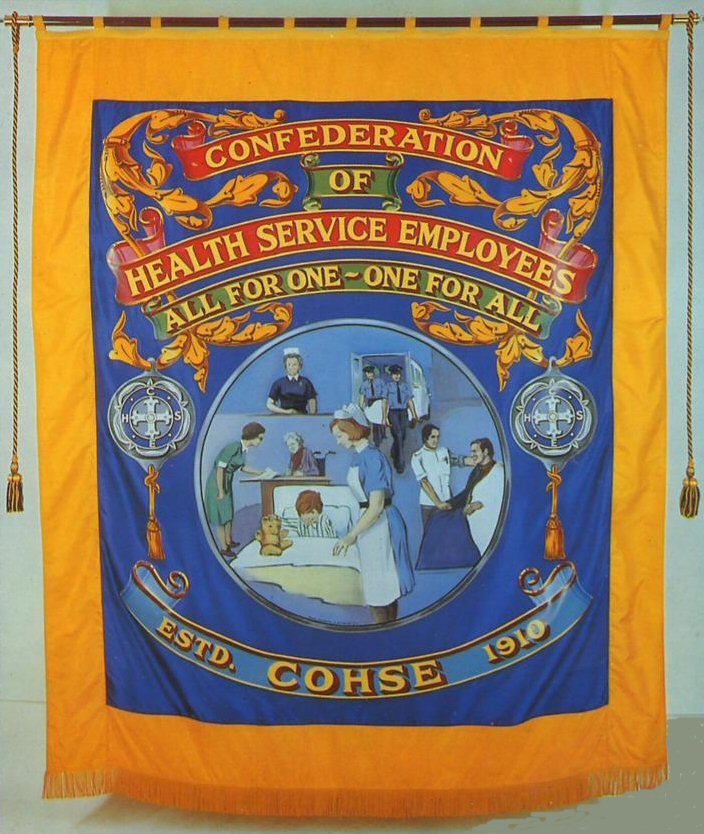
COHSE Banner 1964

The first national banner of COHSE was produced by patients and staff at Darenth park hospital, Dartford in 1964


see picture at March 2007 posting

Group 81


The first newsletter of Group 81 produced at the end of the 1981 COHSE Conference.

Group 81 was effectively the very "broad based" broad left in COHSE.

Hector MacKenzie COHSE General Secretary stated later of Group 81 " We either employed them or they faded away"

Group 81 did play a part in shifting the union from it's right wing axcess to a more "progressive" "main stream" union especially in the areas of equal opportunities

------------------------------------------------------------------------------------------


GROUP 81

INTRODUCTION

Well comrades the farce that was the 1981 (so called) delegate conference is now over. As members go back to their normal routines the feelings of anger and frustration that were so apparent at conference recede. It is important that we stir those feelings again reminding delegates of the blatant control and manipulation that took place a Bridlington. We must also use these opportunities to inform people about the functions and aims of “ Group 81”. We must be seen as an “open conspiracy” willing to discuss our membership of Group 81 with anyone

Group 81 STANDS FOR

1. To establish democratic delegate control of Conference

2. Accountability and democracy within COHSE

3. For a minimum wage of £100 pw linked to 35hr week

4. Eradication of all private medicine

5. full Employment

6. Increased public spending, in health Education and housing.

7. Unilateral Disarmament

8. Equality of all races, creeds, colours and sex

NEC Elections.

If any member is preparing to stand in N.E.C. elections could we suggest tat they do so on a group 81 platform. This would give an opportunity for policies to be discussed and an indication of the potential support we could have within the union, along with the obvious benefits of having a left inclined N.E.C.

September Regional Council

It is suggested that at every regional council in September the following resolution should be on the

"That this Regional Council supports the aims of" Group 81"." Again this would

be an ideal opportunity to discuss our policies and gauge potential support in

the regions. This tactic allows "Group 81" to be seen as an active and

functioning force within the union.

Finance.

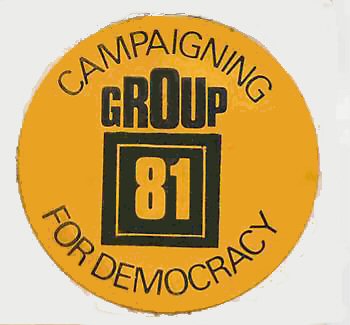
We in-bended to produce badges for the September Regional Council and a magazine around Christmas. Unfortunately these ventures will cost money and branches •which wish to sponsor "Group 81" should send cheques made payable to "Group 81", C/0 Peter Haworth, 55 Millmoor Crescent, Eynsham, Oxon. Bangour 906 and Oxford 645 branches have both contributed £50 to the above fund.

Magazine.

Any member wishing to contribute to a magazine could they please submit articles to myself by the first week in November, We hope to produce a good magazine which will be available for distribution at the January Regional Councils

,CAMPAIGNING FOR DEMOCRACY

Labour Party Deputy Leadership Election

Corades this is going to be our most important task over the next two months.

According to various calculations the Confederations votes at the Labour Party

Conference will be crucial in deciding the outcome of the deputy leadership

battle. The N.E.C. are due to meet on the 6th and 7th of August when they will

decide how the branches are to be consulted over the leadership question. We

must make sure that every branch which supports Tony Benn feeds this information back to Banstead. Hopefully the vast majority of apathetic branches who do not reply to Head Office circulars will maintain their normal consistency. For example to mount a campaign of support for Tony Benn would be counter-productive in Scotland but personal contact will work. Each member is asked to assess their region and use their own "judgment^ in maximising support for Benn.

This has been a very quickly drawn 'news letter to keep delegates .thinking

about "Group 81",Remember we will only survive by your activity.

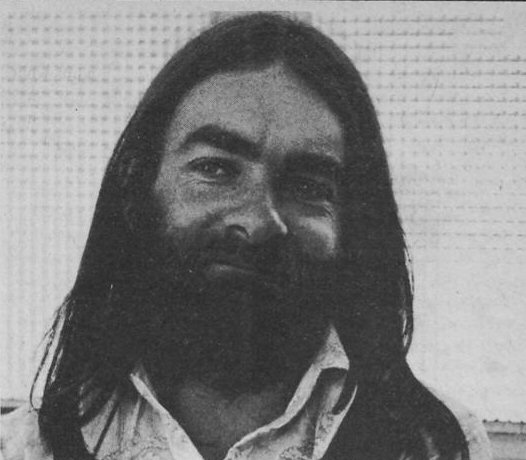
Jim Devine

Branch Secretary

Bangour 906 COHSE Branch


NOTE:
Did Jim Devine get the name Group 81 from the 79 Group the left wing groupiing within the Scottish National Party (later expelled)

National Co-Ordinating Committee against Cuts (NCC) Estb 1975

The National Co-ordinating Committee against Cuts in the NHS (NCC) was elected at a delegate conference on the 'Fight Against the cuts in the NHS', held on 11 October 1975 organised by The Medical Committee Against private Practice (MCAPP).

The conference, with over 500 people attending (395 delegates), unanimously passed a resolution calling for
the transformation of the NHS into a health service responsive to the needs of the working class and under thecontrol of the working class.

The Labour government, under the guise of 'rationalisation', is carrying out closures of hospitals and wards, and cancelling building programmes, which is resulting in staff
redundancies and loss of services to patients.

The health service uniquely represents one of the few gains of the labour movement since the war, and is now being threatened as never before.

The past few years have seen an unprecedented rise in industrial action by health workers to improve conditions of pay and work. These struggles have resulted in significant'
improvement for workers, but the defence of the health service calls for a united response from the whole labour movement for a health service that really caters for peoples'
needs.

The conference resolution, and its implementation through the setting up of local and regional committees, is a first step in that direction.

The National C0-Ordinating Committee against Cuts Officers

CHAIRMAN: Ernie Roberts (assistant gen sec AUEW)
SECRETARY: Dr Paul Stern
NATIONAL ORGANISER: Janet Maguire
Jack Collins NUM executive
Brian Nicholson T&GWU Executive
Ann Holmes representative from Institute of Workers Control
Jim Jackson East London Action Committee against the Cuts
Ron Pearson NUPE United Portsmouth Hospitals
Ken Price NUPE Morriston Hospital Swansea
Steve Johnson NALGO Officer
Sue Lister rapresentative from ASTMS Oxford
Alan Kirkby representative from Hull Port Shop Stewards.Committee
Peter Amiott Medical Committee Against Private Practice (MCAPP)
Dominic Costa (MCAPP) .
Mike Silver (MCAPP)
Colin Smith (MCAPP)
Jack Sutton NUPE Manchester
John Mitchell representative from NATSOPA Joint London Branches
Jo Richardson MP
Patrick McQuade representative from T&GWU Rover Solihull
Steve Ludlum NUPE London
Bob Brett representative from East London NUT
Tom Waterhouse Official representative from NALGO NEC
Sylvia Prentice NALGO London
Ray Perry COHSE Norfolk
Dawn Judd COHSE Cardiff
Bill Starks COHSE Bristol
Ron Griffiths representative from Socialist Medical Association
Doug Cook SW Region TUC
Carolyn McCartney COHSE Norfolk
Paul Mitchell NUPE Southampton
Ron Thompson AUEW Sheffield

Secretary Dr Paul Stern 55 Bridge Lane, London NW11

Bill Geddes 'Rich Bastards' PP Speech 1979


Bill Geddes' speech to NUPE Conference in Scarborough May 1979

used by the Daily Mail to attack the unions campain against private patients

‘I don't want to spend time convincing you that private practice is evil. I would hope that every delegate to this hall is opposed to privilege and all it stands for.

We have already made some progress on this issue. But the problem is that this process is taking so long that the private health service, the BUPA vultures, are being given more time to build up their facilities.

All over the country applications are in the pipeline for permission to build private hospitals and clinics. These establishments are going to draw their staff from the NHS. Look at Camden, North London for example. At one end of the borough the Area Health Authority claims it cannot get enough trained staff to keep the Elizabeth Garrett Anderson hospital open.

At the other end of the borough the private Wellington Hospital is trying to extend its operation with one hundred new beds. They are not going to train new staff for this themselves. The only way that they can staff those beds is to leech off the NHS.


The private sector has its hand round the neck of the NHS..'

Skilled doctors and nurses will be lured away having had the cost of their training paid for by people who can't afford private practice for their bloody cats, never mind themselves.

These people have been trained at the expense of working people and they should not be allowed now to go away and make fantastic money for themselves.

This is a motion with teeth which will succeed if the union begins a campaign from today. It is saying that from January 1 next year, 1980, all NUPE members will refuse to provide any services to private patients, something we've' done in the past but haven't been very well organised in doing it. It gives us seven months to prepare, seven months for the Executive committee to educate the membership on what private practice is and the need to abolish it.

On that day every single rich bastard who comes into the hospital will only be treated on the basis of being a National Health Service patient and not because he's got a bit of extra money to pay the consultant.

The private sector has its hand round the neck of the National Health Service. I think it is our duty in this conference to cut that hand off.

Note:
Bill Geedes NUPE Branch Secretary Hammersmith Hospital
born Scotland 1943

COHSE Medical Services Guild 1948

COHSE Medical Services Guild 1948

A General Meeting arranged by the Medical Advisory Committee was held at the Ambassadors Hotel, London W.C.I. After general business, excellent contributions were received on subjects associated with the
National Health Service.
Dr. H. B., Morgan, MP., outlined the superannuation scheme, dealing with both the English and Scottish regulations, In pointing out that the whole scheme is extremely complicated, he stated that the Ministry were preparing an explanatory document which would lie available in the New Year for everyone concerned.

Dr. Stark-Murray (member of the S.W Metropolitan Regional Board) dealt with the work of the Regional Boards.

One of the tasks they had before them was to set up Hospital Management.
Committees, which would deal with the day-to-day work of the hospitals.

Names could lie submitted now to the Regional Boards for their consideration. One of the difficulties was that the Boards lacked authority at present. In reply to a question on contracts, Dr. Stark-Murray stated these remained to be determined. There was nothing to prevent organizations making representations to the Regional Boards at this juncture on this or smaller
matters.

Dr. Fitzgerald gave a paper on Staff Consultative Committees, and the. Meeting agreed it would be of great value if printed in The COHSE Journal
In bringing the proceedings to a close, the Chairman Dr. Charles Brook, member of the South East Metropolitan Regional Board), expressed tile appreciation of the meeting to those who had made such valuable
contributions.

Dr Charles Brook was COHSE Chairman of the COHSE Medical Services Guild and Labour LCC member

Dr Stark- Murray was also a Socialist Medical Association activist

Irish nurses strike 1980 and 1999

The Irish experience of strike action first occurred in 1980 over a pay dispute.

It lasted 17 days and mostly involved nurses belonging to SIPTU (then known as the Irish transport & General Workers Union - ITGWU)

According to ITGWU Nursing Officer Pat Brady the strike action was successful in that it achieved a major pay increase for nurses.

the union also recruited substantial number of members from the Irish Nurses Organisation (then like the RCN a no strike union)

IRISH NURSES STRIKE 1999

On Tuesday 19th October 1999 by the biggest strike in its history, as 27,500 nurses began indefinite strike action over pay and working conditions.

Members of all four nursing unions backed the strike by massive majorities on October 11. They rejected an offer by the Labour Court (a cross union-government body), which the government claimed amounted to a 23 percent rise on basic salaries.

SIPTU nurses voted 82 percent in favor of strike action, and the Irish Nurses Organisation, voted 96 percent in favor. While smaller unions IMPACT and the Psychiatric Nurses Association members backed the action by 89 percent.

27,000 nurses began on
19 October 1999. The key issue for the nurses was their bid to enhance both their pay and professional status to a level that they felt was commensurate with their qualifications and the professional demands which are made upon them.

The government, for its part, was fearful that further concessions would provoke "knock-on" pay claims elsewhere in the public sector. For this reason, the government was resolute in its determination to face down the nurses, partly in an attempt to dissuade other public sector workers from pressing their own claims. The strike was called off after nine days, after the nurses had secured some concessions that exceeded the terms previously offered following a
Labour Court recommendation

TUC Nurses Charter 1937

1 96-hour fortnight and abolition of 'spread-over' system

[split shifts].

2 Enhanced overtime rates and discouragement of time off

in lieu.

3 Minimum month's holiday with pay.

4 Minimum sick leave with '13 weeks' full and 13 weeks' half

pay.

5 Sickness and disability compensation.

6 Trained nurses to have freedom to choose place of

residence, and nurses' home conditions to be fullv

adequate.

7 Superannuation for all nurses, transferable throughout

the service.

8 Abolition of unnecessary restrictions.

9 The creation of a National Council setting standard pay,

hours and other conditions, and local consultative

committees at hospital level.

10 All probationers to go through preliminary Training

Schools before working on the wards.

11 Facilities for higher training in midwifery, massage

[physiotherapy], etc.

Saturday, April 22, 2006

Roy Oliver - COHSE Gay Rights


Roy Oliver was a nurse and branch secretary at Hungerford Hospital (established 7th August 1968) and later Reading & District COHSE branch.


Lead a successful campaign to save the 100 beded care of the elderly Hungerford Hospital in 1978/79


A key supporter of the Berkshire Joint Trade Union Committee which Roy chaired

A Liberal Councillor in Hungerford (later he defected to Labour).

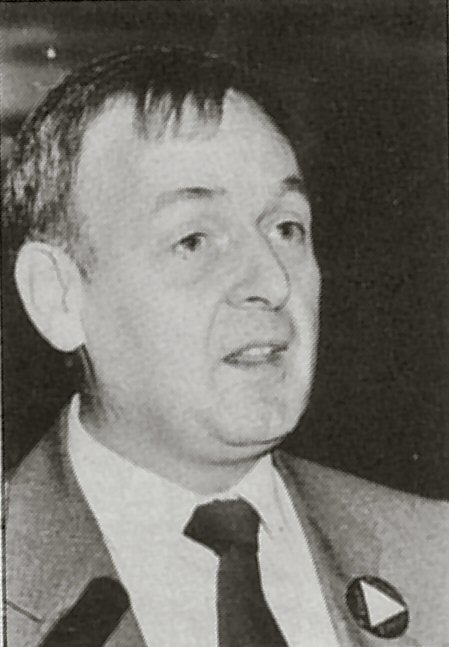
He was a National Executive Committee Member for Region 6 and would wear his pink triangle "Gay Rights" badge with pride.

Roy was a popular NEC member and his popularity helped COHSE in securing an early trade union commitment to Lesbian & Gay rights. However he had earlier been slow handclapped for supporting equality at COHSE Conference.

COHSE's eaarly committment to Lesbian & gay rights culminated in the union refusing to hold its conference on the Isle of Man and its opposition to Clause 28.

Roy was involved in the Battle Hospital Miners Support Group

Like so many of his friends he died young.


NOTE:

The origins of the Reading & District COHSE Branch go back to the establsihment of the COHSE Peppard United Branch formed by branches in the Reading and Henley area in 1952 with Tom Kelly as Branch secretary

Thora Silverthorne - Nurse & Internationa Brigade

Thora Silverthorne

Nurses’ leader and International Brigadier,

Thora Silverthorne was born in Abertillery on the 25th November 1910. She was the daughter of George Richard Silverthorne, a miner at the Vivian & Six Bells Pit and Sarah Boyt of Bargoed. Her early years were spent at 170 Alma Street, Abertillery, she secured a scholarship to Nataglo County School (Hafod) and attended the local Baptist church run by Pastor Rev Ivor Evans.

She joined the Young Communist League at 16 and, when she was old enough, the Abertillery Communist Party. Her father was a founder member of the local Communist Party and active in the miners union. Thora chaired meetings with prominent speakers such as Arthur Horner, the miners’ leader. "Everyone in Abertillery talked politics," she was to say of these times.

With her mother’s early death, as one of seven children, she was forced to leave Abertillery for England. Initially she worked as a nanny for Sutcliffe-Bartlett, the Reading Labour MP, but also fitted in selling the Daily Worker to the local railwaymen.

She then followed her sister into nursing at the Radcliffe Infirmary, Oxford and was involved in Communist Party activities in the city. She participated with her close friend Christopher Hill in the October Club. The health needs of the hunger marchers that passed through Oxford on their way to London were tended to by her “helping her self to bandages and dressings on the wards”. She recalled that “Their feet were often in particularly bad state.”In 1935 Thora secured a Sister’s post at Hammersmith hospital and worked closely with Dr Charles Wortham Brook and his wife, also a nurse, Iris.

In 1935 Thora secured a Sister’s post at Hammersmith hospital and worked closely with Dr Charles Wortham Brook and his wife, also a nurse, Iris.


Joined NUCO Guild of Nurses


At the outbreak of the Spanish Civil War she volunteered to nurse, and was "elected" Matron at Granen hospital, caring for many anti-fascist German soldiers in the Thaelmann Centuria. The International Brigadier, Michael Livesey, died in her - arms a memory she never forgot. Later, she was herself drafted into the International Brigade.

On her return she married Dr Kenneth Sinclair-Loutit, who she had met in Spain, where he was the medical unit's administrator They lived at 12 Great Ormond Street. Loutit was elected as a “unity front” Councillor prior to the War for Holborn, London.

Her involvement as sub editor of Nursing Illustrated led her to establish a nurses union (The National Nurses Association). This was a consciously progressive union for nurses in direct competition with the reactionary (Royal) College of Nursing. The RCN and hospital managers attacked her as “not being a registered nurse” or “paid by Moscow”, during the late 1930s. With the help of Communist Party nurses such as Nancy Blackburn (Zinkin), the Association ran a very high profile campaign to highlight the poor pay and conditions of nurses. The Association latter amalgamated with NUPE. Bryn Roberts, the General Secretary of that union was a native of Abertillery and a man whom Thora admired.

After the war she became a union official in the Civil Service Association. As Secretary of the Socialist Medical Association, she met Attlee and other Ministers to discuss the establishment of the NHS in 1948.

She married Nares Craig (a relative of Lord Craigavon) from Clitheroe, Lancashire a member of the CP’s architect group and retired to Llanfyllin, Powys, North Wales for 25 years. Clive Jenkins and Frank Cousins were regular visitors there. Thora returned to London, to be close to her daughter Lucy Craig/Best (a Haringey Labour Councillor), a few years before her death on 17th January 1999. The funeral service at Marylebone cemetery on 25th January heard `the Valley of Jarama’, `The Internationale’, Cwm Rhondda and a recording of the Welsh hymn “Land of my fathers” by Paul Robeson

Iris Brook Nurse & SMA Activist

Iris Brook (Iris Beynon) born Bedwellty, South Wales 21st January 1903 was a Registered Nurse and Midwife (trained at Barts, where she meet Charles Brook) wife of Dr Charles Brook, (A GP from South East London) London County Council Labour Councillor and founder member of the Socialist Health Association activists Appointed temporary organiser for the National Union of County Officers (NUCO), Guild of Nurses in 1936, (later deputy to Beatrice Drapper) and as such led with Beatrice the first campaign for improved conditions for primarily general nurses 1937. The Royal college of Nursing opposing improvements on the grounds that they would bring the wrong kind of girls into nursing was involved in the first nurses
demonstration in Fleet street when "Uniformed nurses carrying sandwich boards and wearing black masks first descended on an astonished London" active in the Socialist Medical Association herself, involved in the Aid to Spain Movement, her husband was secretary Iris colleagues included Thora Silverthorne of the National Association of Nurses, who she stood with on a number of occasions for election to the General Nurses Council

Lived at Mottingdeane, High Road, Mottingham, London SE9


Died 1984


Friday, April 21, 2006

Beatrice Drapper - Deptford Angel of Mercy

Beatrice M Drapper – Deptford “Angel of Mercy” or “Our Beatrice”
Born Deptford, South London
Student at Scott-Lidgett’s, Bermondsey University Settlement and an orignal member of the "Beatrice" Dunkin, Club for Girls
Beatrice Drapper stated "I owe all my sucess in life to the Settlement"
Lived at 7 Evelyn Street,
Helped in the election of Will Crook’s as MP for Woolwich, one of the first Labour MP’s
A school manager from 1902-1927, Swimming and Gymnastics lecturer for the London county Council Schools & Welfare Board
Labour Councillor for North West Ward, Deptford from 1919 – 1956 (resigned 7/3/1956)
One of the first elected women Mayor’s in Britain, Deptford mayor 1927-1928
Married Mr E. C. Drapper also a Labour Councillor who died in 1945

Helped establish NUCO at St Alfege’s hospital, Greenwich in 1918
Helped organise the feeding of Dockers families during the 1912 dock strike and was a leading figure in the campaign against the Chair of the Port of London authority who kept the Dockers in poverty. She was not alone
“O God strike Lord Davenport dead” prayed Dockers leader Ben Tillett
From 1919 voluntary worker for the Poor Law Workers union (later National Union of County officers and COHSE ) from 1929 – 1946 paid employee of the union.
She was heavily involved in a case involving Peggy O'Neil a nurse suffering from TB of the spine (not then an industrial injury) and a bed patient for six years, with Beatrice help she was able to help Nurse O'Neil start a new life in America.

Justice of the Peace 1921 for Blackheath division

Elected to Greenwich Board of Guardians 1907 -1930 as a Labour representative (three years as Chairman)

During the 1921 she helped feed up to one thousand Dockers at deptford Central hall during the strike "cycling from her home at 5am in the morning in order to serve breakfast".She bought two shops in Deptford and converted them into a club for striking women tin workers who she helped organise into a union, serving 200 meat and veg meals daily at 4d a meal.
The tin workers suffered terrible conditions and were pitifully paid. When they were taken to court for daring to strike she organised coaches to take the women tin workers to the Law courts hearings
Member of Lewisham hospital management committee
Officially opened the Woodlands Nurses home for nurses, Greenwich, December 1925
Appointed Chair of Chelsea Juvenile Court in 1945
Later moved to 46 Coniston Road, Bromley, Kent
Cremated Southend cemetery 4th December 1961

Patrick McHugh - St Pancras Hospital

Patrick McHugh

Born in Ireland 45 years service

Chief Male Nurse at St Pancras Hospital (Observation Unit - psychiatric )

Joined The National Union of County Officers (NUCO) union (Later COHSE)  in 1925. He took a leading part in the early struggles to improve nursing service conditions and was part of the first public demonstration by nurses, when NUCO nurses took part in the "raid on the LCC", when leaflets were thrown into London County Council chamber to highlight LCC Nurses grievances. Patrick also took part in the famous "masked demonstration" by NUCO uniformed nurses, who march down Fleet Street on the 5th April 1938 with sandwich boards stating "we demand fair pay" and a 48 hour week.


speaking in February 1937 Patrick McHugh for NUCO stated

"that the Nursing Executive of the National Union of County Officers were unanimously of opinion that nursing of the Chronic Sick should be done by fully trained nurses. If employing authorities could be persuaded to give more reasonable rates of pay, shorter working hours, and improved conditions, it would go a long -way towards removing the difficulty in obtaining the general trained nurse."

Probably trained initially in Dublin 

Served in France in the RAMC in WW1


A member of NUCO's National Executive Committee


Considered  "A remarkable gift of oratory"

his motto was "Let this day pass no one by"

Member of the board of Governors at the National hospital, Queen's Square

Retired 1952

Died June 29th 1954


Possible

Born 15th May 1887 at Abbeyleix, Laois, Ireland to Thomas McHugh and Mary Keelly. Patrick McHugh married Mary Nevin and had 5 children. 

He passed away on 29th June 1954 in Pancras, London, England.


COHSE Journal


Tudor O Morgan - South Wales

Councillor Tudor O Morgan worked as a nurses at St David’s hospital in Cardiff and became the local branch chairman of the National Union of County Officers (NUCO).

He became chairman of the national unions NUCO Guild of Nurses in the late 1930's.

was secretary of his local Labour party ward and was a Cardiff City Councillor

He retired from the NHS after losing an arm in an accident in 1937

died 1949 aged 53

Frank McCarthy COHSE Regional Secretary stated "Will be remembered as one of the pioneers who worked tirelessly organising nurses and making them conscious of the value of trade unionism"

"His contribution to the building up of NUCO was an inspiration to others

"He did much work around the student nurses campaign in 1948

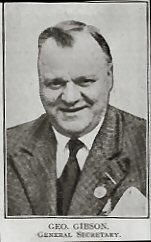
George Gibson - General Secretary


George Gibson was born in Glasgow, Scotland he became a Charge Nurse at Winwick Hospital and soon became active in the National Asylum Workers Union.

He directed the the NAWU militancy after the end of World War One, which resulted in permanent improvements in pay and conditions as well as national bargaining framework.


Elected General secretary of the National Asylum Workers Union 1913


As a member of the TUC he was involved in the TUC's campaign to organise general nurses in the 1930's and the 1937 TUC Nurses Charter.

He was a member of the Rushcliffe Committee which led to the establishment of the Nurses & Midwives Whitley Council in 1948.

He resigned as General Secretary in 1947 and died in 1953.

COHSE Established 1946


The Confederation of Health Service Employees (COHSE) was established on 1st January 1946 with a membership of 40,000.

COHSE was a merger of the Mental Hospital & Institutional Workers Union and the Hospitals & Welfare Services Union.

The need for merger was the belief in an "industrial union" within the proposed National Health Service (Established 5th July 1948).

The idea of including “Confederation" rather than union in the title was felt to be “all-embracing”, expressing the unity of all health staff and allowing for the expression of the views of “any particular or specialist service”.

It was felt that “COHSE” was the best way of shortening the title because it presented the image of a “real” “cosy” and progressive organisation.

Within the new union the dominate force was the MHIWU (25,000 members) with its base amongst nurses in the
Britain's large psychiatric hospitals.

The union’s mental health origins go back to 1910 when the National Asylum Workers Union was established and soon secured a significant membership in the old psychiatric hospitals (Asylum).

It’s head office remained in Manchester (the old MHIWU head office) and the first COHSE General Secretary was George Gibson (formerly of the MHIWU)

COHSE’s motto was

“All for One and One For all

Its logo was a silver and blue rose with a cross through the middle