

Showing posts with label Labour Party. Show all posts
Showing posts with label Labour Party. Show all posts
Sunday, June 14, 2015
Wednesday, April 06, 2011
UNISON Nurses meet Labour Health spokesman after Government "pause".


UNISON Nurses meet Labour Health spokesman after Government "pause".
"UNISON nurses and midwives meet with Labour Health spokesman John Healey and local Tooting MP Sadiq Khan at the House of Commons (4th April 2011) to discuss the on going campaign against the Coalition's NHS & Social Care Bill, after Conservative Health Secretary, Andrew Lansley was forced to invoke a two month pause in the passage of the Bill because of growing opposition from NHS professionals and the public.
Maureen Brown UNISON Nursing Convenor stated "The growing campaign against the NHS Bill, had forced the Government to pause, now we need to move forward with the public to ram home the overwhelming opposition to the NHS Bill and NHS privatisation".
John Healey stated the Government NHS proposals were now weighed down in "confusion, chaos and incompetence" he also referred to Andrews Lansley's ability to unite in opposition to his NHS Reforms former right wing Thatcherite Minister Norman Tebbit and rap star NxtGen, the later responsible for viral video hit Andrew Lansley NHS Rap.
Sadiq Khan MP stated "He would work tirelessly with UNISON, NHS staff and patients to defend the NHS from this vicious attack".


Thursday, April 10, 2008
Labour's Action Plan for theNHS 1991

LABOUR’S ACTION PLAN FOR HEALTH
By Robin Cook MP, 23rd September 1991
(shadow Secretary of State for Health)
THE FIRST TEN STEPS
1. Halt the opting out of hospitals and other units in the second (if before 01/04/92) and third waves
2. Sign the orders bringing back those hospitals and other units that have already opted out
3. Re-name the department, Department of Health and Community Care and appoint a Minister of State with the sole responsibility for care in the community
4. Instruct all hospitals to scrap all tow-tier deals on waiting lists and admit patients in order of medical need
5. Restore the right of GP’s to refer their patients to the hospital of their choice and stop health managers blocking referrals to hospitals where they have not placed a contract
6. Set the terms of reference of the Quality Commission for the health service
7. Declare a moratorium on the privatisation of geriatric services pending a review of the need for public provision for long term care of elderly people
8. Start negotiations to remove the pressure in the GP’s contract to increase patient lists, and fix a lower maximum on patients’ GPs
9. Set up a task force to tackle waiting list black spots
10. Appoint new members of health authorities who represent their local community, live locally and use the NHS
also other points which included
ACTION TO HALT PRIVATISATION
21. Set up an enquiry into weather there is a link between length of waiting lists and the amount of private practice
22. Halt further contracts for the construction of private commercial wings on NHS sites
23. End compulsory competitive tendering in the health service and introduce quality standards for ancillary services
24. Notify private insurance companies of the withdrawal of tax relief for private medical cover
Monday, November 27, 2006
COHSE & Labour 1987

COHSE Hillingdon & District branch General Election leaflet circa 1987
The Conservative Government have since 1979 systematically attacked and undermined Hillingdon's health services, recently a further three hospital -wards and a clinic were closed by Hillingdon District Health Authority.
Since 1979 the effect of this policy in Hillingdon has been:
Over 300 hundred hospital closed
Uxbridge Cottage Hospital closed
St. Johns Hospital closed
7,656 patients on the waiting list
Furthermore, only a determined 'work-in' by hospital staff and the support of the community saved Hayes Cottage and Northwood & Pinner Cottage Hospitas from closure.
Health workers now believe that only the Labour Party cares, and is fully committed to the future of our health services, after all it was the Labour who established the in 1946.
We therefore urge all caring people to support the Labour Party's campaign to save our health service - if the Tories are re-elected with Edwina. Currie as for Health, the future would be very bleak for the health service user. There would be more health cuts, more privatisation and the gradual dismantling of the NHS.
Published by M.Walker COHSE Branch Secretary
Printed by Hillpress 11, Clayton Road, Hayes
Thursday, September 21, 2006
Rev Stanley Morgan 1870-1951

Rev Stanley Morgan 1870-1851
Rev Stanley J.W. Morgan
Described later by COHSE General Secretary Cliff Comer as “small in stature, but big in human kindness ".
His early years seem to have been spent as the Greenhithe Congregational minister in Kent, a position he held for 55 years.
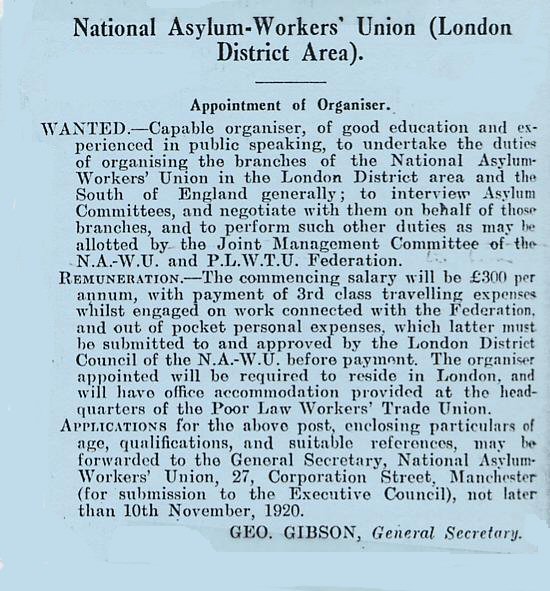
He was appointed as London & Southern Regional Organiser of the newly established “Federation” between the National Asylum Worker Union and the Poor Law Workers Trade Union in 1921 on a salary of £300 a year. Working out of the Poor Law Workers (later Hospital & Welfare Services Union) London
When the Federation was dissolved in November 1922 his services were maintained by the National Asylum Workers Union (later Mental Hospital & Institutional Workers Union).
In March 1922 Rev Stanley Morgan stood as the Labour candidate (with official union support) in the Parliamentary by-election at Faversham , Kent
The General Secretary George Gibson wrote of the Rev Morgan that “he had known him over a period of seventeen years during which time there has been no occasion for the slightest difference of opinion".
The COHSE General Secretary Cliff Comer also a staunch non-conformist stated on his death
“He was one of the most outstanding and striking personalities have ever met. Not everyone was able to take kindly to him because they did not take the trouble to get to know him. To know Stanley
And Mr Cliff Comer also recalled advice Morgan gave him on being appointed a full time officer in1933 “When you come up against prejudice, as you undoubtedly will, do not stop to argue with it; leave it to rot at the roadside where it belongs, and go on your way”.
Comer also recalled Rev Stanley Morgan stating “Comer the world is mad, It will neither have Jesus Christ, nor a sensible economic system to live under”.
Comer also recalled Rev Stanley Morgan stating “Comer the world is mad, It will neither have Jesus Christ, nor a sensible economic system to live under”.
Notes:
Rev Stanley J W Morgan, 26 Cobham Terrace, Greenhithe, Kent (address 1936)
During the heavy air raids on the South Coast during WW2, Rev Stanley Morgan played a key role in organising Sunday church services inside the chalk cliff tunnel's used as air raid shelters .
Syd Chester: "The accordionist in the Greenhithe Tunnel " I learned that every Sunday, during the height of the Blitz, services were held in one of the chalk tunnels at Greenhithe. The vicar was the Rev Stanley Morgan and the congregation was huge. For these people prayers were important. It was typical of that spirit of defiance shown at the time."
Reverend Stanley became Chairman of the West Hill hospital (previously known as King Edward Hospital) in 1910 and remained as Chairman for the next 25 years. He was much respected and worked tirelessly to improve the lives of the poor in Dartford.
In Kent Wilmington Dartford seems to have been named after him. Stanley
And a road in Dartford was named after him
Surely, Rev Stanley Morgan deserves a fitting tribute from the people of Dartford, a people he so tirelessly served.
Thursday, July 27, 2006
Cliff Comer General Secretary 1948-1953

Cliff Comer
COHSE General Secretary 1948-1953
Wells NAWU branch had been established September 1914
He was also a firm Labour Party member and was always active in his local Constituency, serving for many years on the
He then had the distinction in 1932 of being appointed the unions first national organiser, based in the unions office in
In 1938 he was transferred to
Cliff was elected assistant General secretary of the Confederation of Health service employees (COHSE) in 1947 and played a key role in smoothing the teething problems that inevitably resulted from merger and the formation of the new NHS.
In 1948 as “heir apparent” he was elected general secretary as successor to George Gibson.
It was Cliff’s vision and forward thinking that saw COHSE take a major steps towards becoming
He was renowned for his clarity of vision, his sound tactical sense and his total commitment to the union and was according to some “far from the humourless bureaucrat of tradition”. Indeed it was aid he had an “impish” scene of humour and his twinkling smile enlivened any meeting”.
He retired unexpectedly in April 1953 for “personal reasons” but many believed because of his frustration at the lack of growth in membership and the splits on the National Executive Committee.
He attended every union conference from 1926 until 1978, which must be a record.
It must have given him great satisfaction to visit the unions headquarter at Glen house, Banstead,
A non smoker or drinker and strong Christian.
He died
Died 22 September 1976 aged 83
born 1896 ?
Monday, July 17, 2006
Formation of SMAC by Dr Charles Brook
Extract from
Making Medical History circa 1946
By Dr Charles Brook (COHSE , GP, LCC member)
The other activity with which the Socialist Medical Association was so closely associated and which, without the help of the Association would never have achieved such success, was the establishment of the Spanish Medical Aid Committee. My friend, Arthur Peacock, has given an excellent account of
the development and the achievements of the Committee in his recently
published book "Yours Fraternally". Let me quote one paragraph.
“One afternoon in July I had a visit from Dr Charles Brook, General Practioner & L.C.C member who was Secretary of the Socialist Medical Association. “Do you think, Charles asked me “it would be a good idea if we Socialist Doctors sent some medical supplies to
Actually it was at lunch-time on. Friday, July 31st that I discussed the matter with Clifford Troke, and immediately afterwards there was the conversation with Arthur Peacock. The meeting I convened for the following afternoon by hurriedly written postcards and by telephone calls, was very well attended despite the fact that it was the Saturday prior to August Bank Holiday. (SMAC established 1st August) , .
After I had made a statement setting out ray reasons for convening the meeting it was there and then decided to constitute "The Spanish Medical Aid Committee" and although I was hopeful that I might then be allowed to retire into the background the Honorary Secretaryship was thrust upon me.
The majority of the Committee were members of the S.M.A. Christopher
As Chairman H. B. Morgan proved himself to be an extremely able and tactful negotiator. Being a roman catholic he was able to neutralise the powerful pro-Franco elements in his Church, while as Medical Adviser to the T.U.C. he was an invaluable go-between when certain awkward situations arose.
Somerville-Hastings, I was especially indebted. Many volunteers came into the Committees office to lend a hand, but it was impossible to check their bona-fides and as much of my correspondence was strictly confidential, I was in urgent need of a private secretary. When I put the position to Somerville Hastings, he immediately handed, me £25 on order help defray the cost, without it being a charge on the Committees funds.
Within a few day’s of the Committee being established, the public response was so generous and there were so many volunteers for service in
Soon after this project was agreed to, I made up my mind that the first-British Medical Unit had got to be ready to leave by Sunday, 23rd August 1936, and on that day thousands of Londoners were stirred by the sight of a procession of vehicles going from the Committee's Headquarters to Victoria Station, where in the presence of a vast crowd and many London Mayors, Arthur Greenwood and. Alan Findlay, then Chairman of the General Council of the T.U.C. delivered valedictory speeches.
This was just three weeks after the Spanish Medical Aid Committee had been constituted and it was the first real practical demonstration of support for the Spanish Republicans which sympathisers in the country had provided.
I remained as Honorary Secretary, of the Committee until the end of 1936 when George Jeger, now M.P. for
Saturday, July 15, 2006
Spanish Civil War 1937
Labour and Spain.
NATIONAL CAMPAIGN OF DEMONSTRATIONS 1937
"Freedom, Food and Justice—End Fascist Intervention in
The central purposes of the campaign are to demand the withdrawal of foreign troops from
to buy arms, and to assist in relieving the acute food shortage and the distress which afflicts vast numbers of Spanish refugees.
Demonstrations will be held in
In addition a large number of local meetings will be organised at which national speakers will take part.
The campaign will be conducted on a large scale and with intensive effort, and will conclude with- a great central demonstration in
Mental Health & Institutional Workers
MH&IWU Conference 1937
Resolution on Spanish Civil War
"That this Annual Conference expresses its abhorrence of the continued participation by organised units of the Fascist and Nazi Forces in the Spanish Civil War on the side of the Spanish Rebels; expresses its horror at the indiscriminate bombing and shelling of open villages and towns, as a consequence of which women and children are being slaughtered in the holocaust of war, and demands that the Government shall bring this matter to the notice of the League of Nations with a view to organised intervention [on behalf of the legitimate Spanish Government."
George Gibson General Secretary :In moving this resolution I do not propose to discuss the merits or demerits of the various forms of Government in
War, of necessity, is a terrible thing and must, and always will, involve cruel suffering on the part of tile people, but when the modern weapons of destruction are deliberately used against non-combatants, as they were at Guernica and Almeria, it is time for decent people to express their disgust at this method of trying to terrorise one's opponents ; and, whatever be the merits or demerits of the Spanish conflict, it is an undeniable fact that the Government of Spain was the duly elected Government of the people and that those who took up arms against it are, in tact, rebels, whether they have titles, honours, or military distinctions attached to their names. Now, all of us, I believe, wish to see the Spanish Government victorious.
Some may differ on certain aspects of the conflict, but I ask you, whatever your differences may be on this matter, to support the resolution.
Mr. Scovell, (Whitecroft) : I second the resolution and would point out that the fight which the Spanish Government and people are putting up for the maintenance of democratic rule is as much our battle as theirs.
Mr Bond (
The same sort of thing happened in the trouble between
Mr Hallinson(St. Bernard's, Southall) : I ask you to accept as an addendum to the resolution after the word " Intervention" in the last line: " On behalf of the legitimate Spanish Government." —(Agreed). It is time our movement became more active in its support of the Spanish Republican Government. I looked through the June issue of our Journal and never a word was said about the Spanish situation, the outcome of which is of such vital importance to peace-loving people. More should be written in the Union Journal about it to create interest among our members and to enlist their support for our comrades fighting the battle of democracy in
The Resolution was Carried Unanimously.
Mental Health & Institutional Workers
MHIWU later became COHSE and in 1993 Unison
Saturday, April 22, 2006
Iris Brook Nurse & SMA Activist

demonstration in Fleet street when "Uniformed nurses carrying sandwich boards and wearing black masks first descended on an astonished London" active in the Socialist Medical Association herself, involved in the Aid to Spain Movement, her husband was secretary Iris colleagues included Thora Silverthorne of the National Association of Nurses, who she stood with on a number of occasions for election to the General Nurses Council
Lived at Mottingdeane, High Road, Mottingham, London SE9
Died 1984

Friday, April 21, 2006
Beatrice Drapper - Deptford Angel of Mercy

Beatrice M Drapper – Deptford “Angel of Mercy” or “Our Beatrice”
Born Deptford, South London
Student at Scott-Lidgett’s, Bermondsey University Settlement and an orignal member of the "Beatrice" Dunkin, Club for Girls
Beatrice Drapper stated "I owe all my sucess in life to the Settlement"
Lived at 7 Evelyn Street
A school manager from 1902-1927, Swimming and Gymnastics lecturer for the London
Labour Councillor for North West Ward, Deptford from 1919 – 1956 (resigned 7/3/1956 )
Helped establish NUCO at St Alfege’s hospital,
“O God strike Lord Davenport dead” prayed Dockers leader Ben Tillett
Elected to Greenwich Board of Guardians 1907 -1930 as a Labour representative (three years as Chairman)
During the 1921 she helped feed up to one thousand Dockers at deptford Central hall during the strike "cycling from her home at 5am in the morning in order to serve breakfast".She bought two shops in Deptford and converted them into a club for striking women tin workers who she helped organise into a union, serving 200 meat and veg meals daily at 4d a meal.
The tin workers suffered terrible conditions and were pitifully paid. When they were taken to court for daring to strike she organised coaches to take the women tin workers to the Law courts hearings
Member of Lewisham hospital management committee
Officially opened the Woodlands Nurses home for nurses, Greenwich
Appointed Chair of Chelsea Juvenile Court
Later moved to 46 Coniston Road
Cremated Southend cemetery 4th December 1961
Subscribe to:
Posts (Atom)
