NAWU Recognition
In December 1913 it was reported in the National Asylum Workers Union (NAWU) Magazine that in the three years since formation the following insitutions had agreed to official recognition of the NAWU
Cardiff Asylum
Durham Asylum
London County Council
Porstmouth Asylum

Showing posts with label LCC. Show all posts
Showing posts with label LCC. Show all posts
Friday, October 13, 2006
Thursday, September 21, 2006
Rev Stanley Morgan 1870-1951

Rev Stanley Morgan 1870-1851
Rev Stanley J.W. Morgan
Described later by COHSE General Secretary Cliff Comer as “small in stature, but big in human kindness ".
His early years seem to have been spent as the Greenhithe Congregational minister in Kent, a position he held for 55 years.
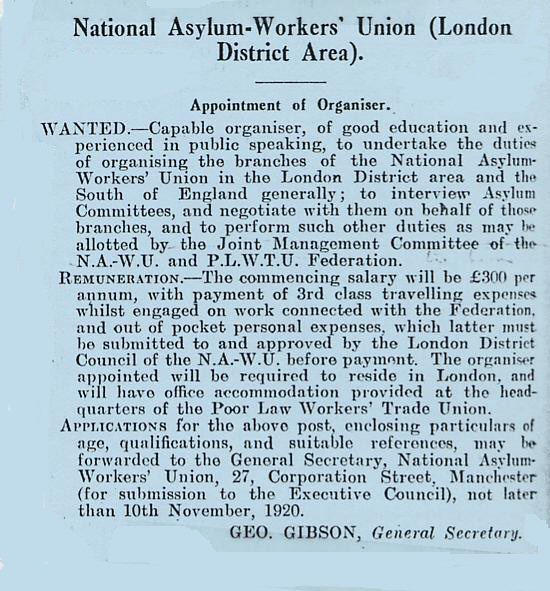
He was appointed as London & Southern Regional Organiser of the newly established “Federation” between the National Asylum Worker Union and the Poor Law Workers Trade Union in 1921 on a salary of £300 a year. Working out of the Poor Law Workers (later Hospital & Welfare Services Union) London
When the Federation was dissolved in November 1922 his services were maintained by the National Asylum Workers Union (later Mental Hospital & Institutional Workers Union).
In March 1922 Rev Stanley Morgan stood as the Labour candidate (with official union support) in the Parliamentary by-election at Faversham , Kent
The General Secretary George Gibson wrote of the Rev Morgan that “he had known him over a period of seventeen years during which time there has been no occasion for the slightest difference of opinion".
The COHSE General Secretary Cliff Comer also a staunch non-conformist stated on his death
“He was one of the most outstanding and striking personalities have ever met. Not everyone was able to take kindly to him because they did not take the trouble to get to know him. To know Stanley
And Mr Cliff Comer also recalled advice Morgan gave him on being appointed a full time officer in1933 “When you come up against prejudice, as you undoubtedly will, do not stop to argue with it; leave it to rot at the roadside where it belongs, and go on your way”.
Comer also recalled Rev Stanley Morgan stating “Comer the world is mad, It will neither have Jesus Christ, nor a sensible economic system to live under”.
Comer also recalled Rev Stanley Morgan stating “Comer the world is mad, It will neither have Jesus Christ, nor a sensible economic system to live under”.
Notes:
Rev Stanley J W Morgan, 26 Cobham Terrace, Greenhithe, Kent (address 1936)
During the heavy air raids on the South Coast during WW2, Rev Stanley Morgan played a key role in organising Sunday church services inside the chalk cliff tunnel's used as air raid shelters .
Syd Chester: "The accordionist in the Greenhithe Tunnel " I learned that every Sunday, during the height of the Blitz, services were held in one of the chalk tunnels at Greenhithe. The vicar was the Rev Stanley Morgan and the congregation was huge. For these people prayers were important. It was typical of that spirit of defiance shown at the time."
Reverend Stanley became Chairman of the West Hill hospital (previously known as King Edward Hospital) in 1910 and remained as Chairman for the next 25 years. He was much respected and worked tirelessly to improve the lives of the poor in Dartford.
In Kent Wilmington Dartford seems to have been named after him. Stanley
And a road in Dartford was named after him
Surely, Rev Stanley Morgan deserves a fitting tribute from the people of Dartford, a people he so tirelessly served.


Monday, July 17, 2006
Formation of SMAC by Dr Charles Brook
Extract from
Making Medical History circa 1946
By Dr Charles Brook (COHSE , GP, LCC member)
The other activity with which the Socialist Medical Association was so closely associated and which, without the help of the Association would never have achieved such success, was the establishment of the Spanish Medical Aid Committee. My friend, Arthur Peacock, has given an excellent account of
the development and the achievements of the Committee in his recently
published book "Yours Fraternally". Let me quote one paragraph.
“One afternoon in July I had a visit from Dr Charles Brook, General Practioner & L.C.C member who was Secretary of the Socialist Medical Association. “Do you think, Charles asked me “it would be a good idea if we Socialist Doctors sent some medical supplies to
Actually it was at lunch-time on. Friday, July 31st that I discussed the matter with Clifford Troke, and immediately afterwards there was the conversation with Arthur Peacock. The meeting I convened for the following afternoon by hurriedly written postcards and by telephone calls, was very well attended despite the fact that it was the Saturday prior to August Bank Holiday. (SMAC established 1st August) , .
After I had made a statement setting out ray reasons for convening the meeting it was there and then decided to constitute "The Spanish Medical Aid Committee" and although I was hopeful that I might then be allowed to retire into the background the Honorary Secretaryship was thrust upon me.
The majority of the Committee were members of the S.M.A. Christopher
As Chairman H. B. Morgan proved himself to be an extremely able and tactful negotiator. Being a roman catholic he was able to neutralise the powerful pro-Franco elements in his Church, while as Medical Adviser to the T.U.C. he was an invaluable go-between when certain awkward situations arose.
Somerville-Hastings, I was especially indebted. Many volunteers came into the Committees office to lend a hand, but it was impossible to check their bona-fides and as much of my correspondence was strictly confidential, I was in urgent need of a private secretary. When I put the position to Somerville Hastings, he immediately handed, me £25 on order help defray the cost, without it being a charge on the Committees funds.
Within a few day’s of the Committee being established, the public response was so generous and there were so many volunteers for service in
Soon after this project was agreed to, I made up my mind that the first-British Medical Unit had got to be ready to leave by Sunday, 23rd August 1936, and on that day thousands of Londoners were stirred by the sight of a procession of vehicles going from the Committee's Headquarters to Victoria Station, where in the presence of a vast crowd and many London Mayors, Arthur Greenwood and. Alan Findlay, then Chairman of the General Council of the T.U.C. delivered valedictory speeches.
This was just three weeks after the Spanish Medical Aid Committee had been constituted and it was the first real practical demonstration of support for the Spanish Republicans which sympathisers in the country had provided.
I remained as Honorary Secretary, of the Committee until the end of 1936 when George Jeger, now M.P. for
Subscribe to:
Posts (Atom)
