
A young recently appointed COHSE officer.
David Williams, Denbigh (North Wales) Nurse and future COHSE General Secretary.
Here (centre) with the great Nye Bevan at COHSE conference 1953 and still campaigning for the NHS in 2016


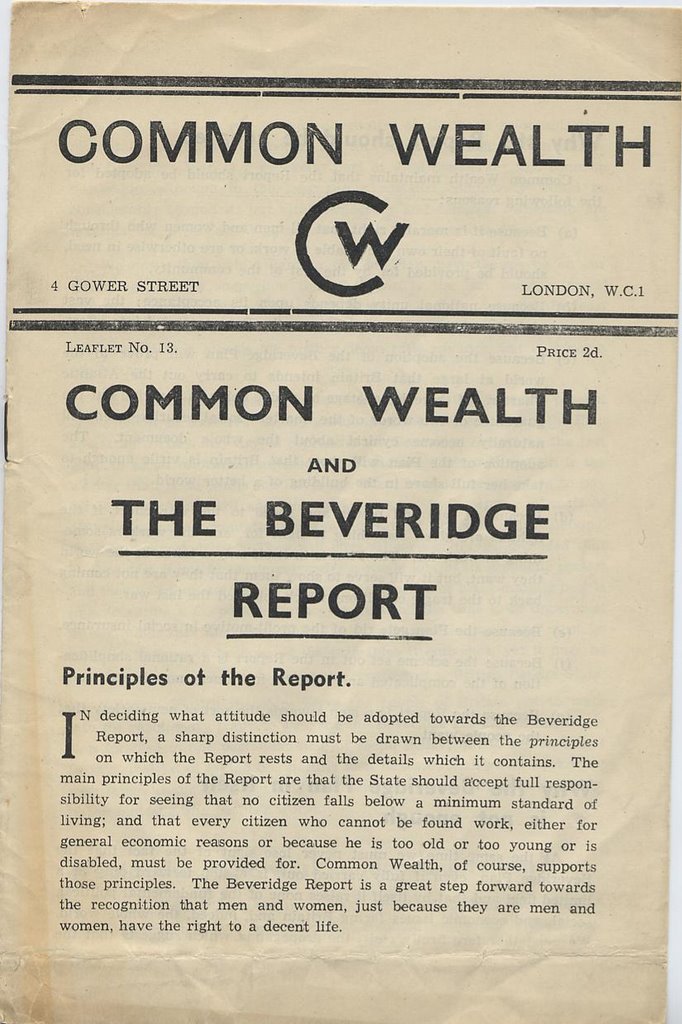
COMMON WEALTH AND THE BEVERIDGE REPORT
Principles of the Report-
Why the Report should be adopted.
Common Wealth maintains that the Report should be adopted for the following reasons:—
(a) Because it is morally right that all men and women who through no fault of their own are unable to work, or are otherwise in need, should be provided for by the rest of the community.
(b) Because national unity depends upon its acceptance: the vast majority of the nation want to see the Report carried into effect.
(c) Because the adoption of the Beveridge Plan will prove to the world at large that
(d) Because it will add power and speed to the war effort if the fighters are given something to fight for, and the workers something to work for. The Plan is in itself only a token of the world they want, but it will serve to show them that they are not coming back to the tragic conditions which followed the last war.
(e) Because the Plan gets rid of the profit-motive in social insurance.
(f) Because the scheme set out in the Report is a rational simplification of the complicated and wasteful machinery now in existence.
(g) Because the Report is a step towards the sort of new society that the people want.
Why the Beveridge Plan in itself is not enough.
At the same time we must never lose sight of the fact that the Beveridge Plan, even it fully carried out, is a step forward only in a limited field and that by itself it raises none of the fundamental political, social, and economic issues facing
We must therefore firmly resist the propaganda which suggests that the Beveridge Plan is in any way an alternative to the basic re-organisation of
We must, then, while fighting for the Plan, nevertheless be on our guard against the suggestion that the Plan is the last word in social reform. Beveridge himself says that he was asked only to solve the least difficult of Britain’s reconstruction problems. The Plan is a beginning, not an end: it is a basis for further democratic advance, but it is not a revolution.
This caution is necessary since it is quite possible that the present Government, or some reactionary grouping of the future, may use the Plan as a trap. They may try to represent the Beveridge Report as the last word in social reform, an anteroom to
Common Wealth therefore urges the people of Britain not to walk into the reactionary trap: to welcome the Beveridge Plan as an important .top forward in one particular field of social policy, but to see to it that Britain, instead of taking one halting step forward, shall go. on advancing with seven-league boots towards vital democracy and common ownership, to the building of a people’s world.
Would the Plan work under Capitalism?
In theory the Plan could be applied without disturbing the capitalist order; Beveridge is not convinced that common .ownership is the necessary fundamental basis for a democratic economic reconstruction. But against this there are several important facts to show that, whereas the Plan might be made to work under Capitalism by conscripting labour, it, would work much more certainly and smoothly under a, system based on the common ownership of the great resources.
I—The Plan “assumes the maintenance of employment and theprevention of mass unemployment.” It requires that unemployment shall not much exceed 1,500,000, and the abolition of “unemployment prolonged year after year for the same individual.” Obviously any such social security measure cannot be financed if too many are drawing benefits from it. Common Wealth, however, is convinced that mass unemployment cannot ‘be avoided for more than a few years after the war at most, so long as the great resources of the country remain in private hands, except by applying Fascist compulsion to the workers. Common ownership is the only final remedy ‘against mass unemployment. Once all the resources of the country appear on a single balance sheet it is obvious that the country will keep all its workers employed. The establishment of common ownership would cut out all but residual unemployment, and would thus so reduce the ‘costs of administering the Plan that it would probably be possible to’ halve the period during which the pension rates are to mature. The Government speakers in the recent debate were sceptical as to how such a plan could be financed: and rightly so. The present system provides no cure for unemployment, and the capitalists consequently foresee great difficulties in financing the scheme.
II.—Capitalism has nothing but intimidation and compulsion to use as “an effective safeguard against the abuse of unemployment benefit “ (to quote Sir John Anderson). That is why the Government is afraid to accept the Beveridge recommendations concerning unemployment and disability benefit. These, the Government maintains, “will have to be of limited duration,” presumably giving place to public assistance subject to a means test. In fact Capitalism is so morally bankrupt that it has to fall back on the fear of destitution as the spur to induce men to work.
It is true that so long as the people have no sense of owning their- country, so long as they do. not feel production to be “their show, “ some abuse of any social security scheme must be expected. This is the inevitable response of the workers to the profit-snatching of the owners. But once the country really belongs to the people, and improved production means a genem.1 rise m the standard of living for all (or the building up of facilities in which all share), dodging work becomes a social crime which the workers themselves will unanimously condemn. Piece-rates will no longer be regarded as a whip, but as a stimulus. The experience of the
III.—Maximum production after the war will give us not only the means for working the Beveridge Plan, but for all the other, measures that should accompany it. Maximum production, however, cannot be attained after the drive of war has passed-though nothing less than maximum production will suffice in post-war
The Trade Unions, instead of having to squander much of their energies infighting the “bosses” on .behalf of the “workers,” will be able to devote their activity towards fulfilling the national production plan, while still protecting the interests of their members. An industry harmoniously run and highly productive will more than compensate for the changes in
IV.—The Government spokesmen approved of Beveridge’s suggestions for compulsory training and his demand that labour must be kept fluid after the war. These, indeed, are essential conditions for an island such as ours, where resources of men and material may often have to be switched over from one industry to another, not only to meet our own internal needs, but in response to the changing demands of foreign countries.
But will not many workers be unwilling to change their jobs, especially if this means changing their place of residence, so long as the main reason for doing so, appears to. be that of benefiting the balance-sheets of private owners? It is only when they .see that the .transfer of their service is going to benefit the whole community that they will be willing to transfer, where necessary, and that compulsion will thus become unnecessary.
V.—The Government is afraid of accepting the Beveridge pension proposals because it is aware that the average age of the nation is constantly rising, and that when the number of pensioners relative to the number of workers has passed a certain point the cost of pensions will become unmanageable.
This increase in age is due to the fall in the birth-rate, and this in turn is due to our present economic system. While Capitalism was expanding the birth-rate rose; now that Capitalism is increasingly restrictive the rate is steadily falling. Allowances for children cannot cure this.
Once again, the experience of the
The Government’s attitude to the Report.
The tragedy of the Government’s attitude to the Report, as it has been so far disclosed, is that the ‘scheme, as, the Government propose to amend it, would no longer be a real social security measure—in spite of Mr. Morrison’s claim that 70 per cent. of the Report is left intact. Sir Kingsley Wood spoke of “priorities.” Priority No. 1 in the Government mind is that private ownership shall not be touched. Not only the insurance companies, but “the position of the big voluntary hospitals must be safeguarded, “ and also the “ well-being and integrity of the medical profession.” The means test is to be retained for the unemployed and the disabled, industrial disability pensions (up to a maximum of £3 plus allowance for children) are declared to be “difficult to justify.” The essential principles of. adjusting benefit to the prevailing cost of living is brushed aside as “very difficult if not impracticable.” Children’s allowances are cut down to the extent of 1/6 per head per week (even if the Government’s promise of services worth 2/6 is carried into effect). The scheme for retirement pensions is so altered as to cancel the aim of the Report, that is,- of ultimately providing a genuine maintenance rate. In spite of Mr. Morrison’s assurances, in fact, what will be left, if these amendments are adopted, is something which the Government would have had to concede had the Report never .been written. Nothing is left to inspire men’; nothing to make man’s hopes of the future rise high; nothing to make the Report what it should have been: “a landmark not only in
Sir William himself, writing in The Observer (February 28’th, 1943) has said: “My Plan takes as its aim abolition of Want. The Government in regard to pensions wholly, and in regard to children’s .allowances and to unemployment and disability benefit to a lesser extent, abandon that aim.”
The reactionaries have opposed the Report for a number of reasons. Sir Kingsley Wood (who was the champion of the insurance companies against Lloyd George when he tried to establish a State funeral grant in 1911) slammed the door on it with some jubilation, as though welcoming the opportunity of rapping the knuckles of those who are daring to expect something better than the 1939 world after the war. Those whose particular vested interests were threatened opposed it for personal reasons; those who are afraid of yielding to any popular demand, in case it starts a landslide, opposed the Report on principle. Others again, although they do not ‘actually want men to go hungry and would like to put through a real social security measure in order to strengthen the position of the ruling group, are afraid to do so because they are beginning to see that if the plan is to be worked properly it will involve doing away with our present system and substituting common ownership—for every major objection that was raised in the debate falls to pieces once we start to think in terms of common ownership of the great resources and a national plan for production democratically drawn up and fulfilled.
We must oppose any watering-down of the Plan, especially as it was drawn up to supply only minimum subsistence.
We must not allow ourselves to be deceived by the plea .that the Plan, even if adopted in full, is sufficient, and that
We must work to bring about common ownership as the goal towards which the Report leads, and as the only order under which the proposals of the report can be put into effect smoothly, certainly, and democratically.
We must remember that the Report itself says: “Freedom from want cannot be forced on a democracy or given to a democracy. It must be won by them. Winning it needs courage and faith and a sense of national unity; courage to face facts and difficulties and overcome them; faith in our future and in the ideals of fair-play and freedom for which century after century our forefathers were prepared to die; a sense of national unity over-riding the interests of .any class or section."
We must fight for the whole Plan now as the first' step towards the sort of World the people want.
WE WON'T LET THEM SHELVE ST.
Approved by
The National Committee of Common Wealth Party,
Published By
C. W. Publishing, Ltd.,
Printed By
J. B. Mackie & Co. Ltd.,


