Showing posts with label Ireland. Show all posts
Showing posts with label Ireland. Show all posts
Friday, January 10, 2014
Tuesday, August 06, 2013
Irish Nurses - Irish dancing 1973

COHSE Journal February 1973
Irish Dancing
Dear Sir,
For the benefit of Irish staff in hospitals in the Balham, Tooting, Wandsworth and Mitcham areas, the Collins (could be Connolly) School of dancing every Sunday morning at St. Augustine's Hall, Broadwater Road, Tooting, London SW17. The centrally heated hall is just a few minutes walk from Tooting
Broadway Tube Station, and is convenient
Any staff who have children that would like to take up. the challenge of Irish dancing, may bring them along any Sunday morning at 11.30 to 1.30.
M. McGrath RMN
For the benefit of Irish staff in hospitals in the Balham, Tooting, Wandsworth and Mitcham areas, the Collins (could be Connolly) School of dancing every Sunday morning at St. Augustine's Hall, Broadwater Road, Tooting, London SW17. The centrally heated hall is just a few minutes walk from Tooting
Broadway Tube Station, and is convenient
Any staff who have children that would like to take up. the challenge of Irish dancing, may bring them along any Sunday morning at 11.30 to 1.30.
M. McGrath RMN
Registered Mental Nurse
Springfield Hospital
Tooting
London
SW17
Note:
This letter from an Irish nurse working at Springfield hospital, Tooting, South London to the COHSE journal highlights the links between Irish male nurses and mental hospital nursing in England and the scope of Irish cultural links of migrant workers in the 1970's (and also union involvement of irish nurses in England and in particular in COHSE, sometimes jokingly refered to at the time as "a male Irish charge nurse mafia"


Friday, February 18, 2011
Irish Student Nurses Fighting Back !


Student nurses warn of cut backlash
By: MARTIN WALL, Industry correspondent
February 16, 2011
The Irish Times
Over 3,000 student nurses and midwifes have taken part in a rally at the Department of Health in Dublin today in protest at Government plans to
phase-out and ultimately eliminate payments for their mandatory 36-week placement in hospitals.
Siptu nursing official Louise O'Reilly said that nurses would punish those who made the decision to introduce the cuts in the forthcoming general election.
Liam Dolan from the Irish Nurses and Midwives Organisation urged student nurses to tell their TDs that they would not vote for them if they did not pledge to reverse the cuts.
Mr Dolan said that the unions would meet with Fian na Fáil on the issue tomorrow.
Des Kavanagh of the Psychiatric Nurses Association said the decision to make the cuts was a final act of betrayal by the former minister of health Mary Harney.
He said the Opposition parties should be clear and unambiguous in their support for student nurses and that "woolly soundbites are not acceptable."
Minister for Health Mary Coughlan last week has asked the secretary-general of her department to carry out a review of the decision to abolish student nurse payments from 2015.
It is understood the review will focus only on the plan to abolish completely the payments from 2015 and plans to reduce the level of payments made to student nurses and midwives over the coming years will remain in place.
The Government announced in late December that it planned to reduce and ultimately abolish payments made to fourth-year nurses and midwives in training during their mandatory 36-week placements in hospitals.
They are currently paid 80 per cent of the salary of a staff nurse during this period.
The Department of Health estimates the cuts will ultimately generated savings of €28 million.
About 3,500 student nurses and midwives took part in demonstrations at 13 hospitals around the country last Wednesday against the planned cuts as unions promised to make them a major issue in the general election.

Wednesday February 16 2011
Irish Independent
Angry student nurses have warned politicians they will be punished in the General Election unless plans to abolish their pay during ward placements are reversed.
Up to 3,000 protesters marched through Dublin and staged a rally at the Department of Health over proposals to phase out payments to fourth-year students working on wards during a nine-month internship.
Security staff padlocked the gates around Hawkins House and senior health chiefs quickly left for lunch before nurses and midwives arrived en masse to hand in a letter calling on the in-coming minister to reverse the plan.
Louise O'Reilly, Siptu's national nursing official, told noisy demonstrators the cuts were a new low for the Government.
"We will hold our politicians to account and shame those cowards who will not pledge to reverse those cuts," she said.
"We say no to slave labour and we will punish those on February 25 who try to introduce it."
Student nurses and midwives are currently paid 80pc of the salary of a staff nurse during their mandatory 36-week placements in hospitals.
Tanaiste Mary Coughlan has asked officials to carry out a review of a decision to reduce and ultimately abolish payments over the next four years.
Four-year-old Ella Dowd dressed in a nurses uniform to support her mother Tara and aunt Maria, both from Swords, north Dublin.
Tara, a second-year psychiatric nursing student at Trinity College, fears she could be forced to leave her course if her pay is cut in her final year.
The 26-year-old lone parent already studies, has placements in St Patrick's Hospital, works weekends for an agency and cares for her daughter.
"This would make a huge difference. I'd probably end up dropping out because I couldn't afford to run my home, Ella's creche and a childminder for weekends," she said.
Maria, 20, a third-year psychiatric nursing student, added: "Next year I will have my own patients and will be administering their medications.
"That is a huge responsibility for anyone to have. Intern doctors will still get paid, why are intern nurses getting cut?"
Union leaders from the Irish Nurses and Midwives Organisation (INMO), the Psychiatric Nurses Association (PNA), and Siptu are holding talks with members of each political party, including Fianna Fail, for their stance on the cuts.
INMO general secretary, Liam Doran, warned his members and their families, who wield more than 200,000 votes, will be told the reply from each party before they go to the ballot boxes.
Fourth-year pre-registration nurses and midwives will also be balloted for a withdrawal of labour in early March if they do not secure a resolution.
Saturday, December 01, 2007
Workhouse Dance at gun point

Made A Prisoner
Bawnboy Workhouse Master
Sinn Feinners Sunday dance The Bawnboy Sinn Fein Club showed its power on Sunday evening, when a body of men proceeded to the Workhouse in the village, and having made a prisoner of the Workhouse Master, held a dance in the boys schoolroom in the institution, contrary to a notice already given that the dance would not be permitted.
It appears that at a meeting of the Guardians held on the 8th inst, it was decided that permission be given to the local Sinn Feiners for the entertainment.
The decision of the Guardians having being communicated to the Local Government Board, the latter body wrote to the clerk of the Guardians was illegal and threatened an injunction in the superior courts.
The Master of the Workhouse, hearing this at once communicated with the secretary of the local Sinn Fein Club, stating that the dance would not be permitted.
Despite this an advance guard of the Republicans made their way to the office of the Master Mr P. McTeigue and imprisoned him there until the crowds for the dance, which numbered over 200 had assembled and taken possession of the boys schoolroom, when the prisoner was released
Tyrone Impartial Reporter 18th October 1917
NOTE
At Strabane Workhouse in February 1922.
Five or six masked (IRA) men entered the Workhouse and set fire to it in order to stop the local Dorset Regiment occupying it.
Bawnboy Workhouse Master
Sinn Feinners Sunday dance The Bawnboy Sinn Fein Club showed its power on Sunday evening, when a body of men proceeded to the Workhouse in the village, and having made a prisoner of the Workhouse Master, held a dance in the boys schoolroom in the institution, contrary to a notice already given that the dance would not be permitted.
It appears that at a meeting of the Guardians held on the 8th inst, it was decided that permission be given to the local Sinn Feiners for the entertainment.
The decision of the Guardians having being communicated to the Local Government Board, the latter body wrote to the clerk of the Guardians was illegal and threatened an injunction in the superior courts.
The Master of the Workhouse, hearing this at once communicated with the secretary of the local Sinn Fein Club, stating that the dance would not be permitted.
Despite this an advance guard of the Republicans made their way to the office of the Master Mr P. McTeigue and imprisoned him there until the crowds for the dance, which numbered over 200 had assembled and taken possession of the boys schoolroom, when the prisoner was released
Tyrone Impartial Reporter 18th October 1917
NOTE
At Strabane Workhouse in February 1922.
Five or six masked (IRA) men entered the Workhouse and set fire to it in order to stop the local Dorset Regiment occupying it.
8 Hour Day - Nurses 1920

15 May 1920
--
EIGHT HOURS’ DAY IN DUBLIN.
The Corporation of Dublin, which makes grants to various hospitals in the city, has decided to make such grants conditional upon the establishment of an eight hours’day for nurses.
In this connection several medical contemporaries take exception to this decision on the ground that in the case of a nurse work and duty are not co-extensive, though no doubt she is liable to answer a bell or call at any moment.”
That may be the case with private nurses, but we have yet to meet the hospital nurse who spends “ much of her time on duty sitting down,” There is a very wrong conception prevalent of the way in which hospital nurses work, It is usually at full
--
EIGHT HOURS’ DAY IN DUBLIN.
The Corporation of Dublin, which makes grants to various hospitals in the city, has decided to make such grants conditional upon the establishment of an eight hours’day for nurses.
In this connection several medical contemporaries take exception to this decision on the ground that in the case of a nurse work and duty are not co-extensive, though no doubt she is liable to answer a bell or call at any moment.”
That may be the case with private nurses, but we have yet to meet the hospital nurse who spends “ much of her time on duty sitting down,” There is a very wrong conception prevalent of the way in which hospital nurses work, It is usually at full
Monday, March 05, 2007
COHSE Leopardstown Park Hospital, Dublin

Leopardstown Hospital, Dublin
It is a little known fact that, COHSE had a branch of the union in Dublin for many years.
The COHSE branch was based at Leopardstown Park Hospital, a British War Pensions hospital located at Blackrock, Co Dublin opened in 1917.
The building is large mansion house in 100 acres of grounds, given by the Powers (Whisky) family.
The hospital was established to care for injured Irish soilders in the British Army. It was administered by trustees of the British Department of Health and hospital staff were paid British NHS Whitley pay rates
The COHSE branch was established in 1948 by Jim Doyle a ward assistant (later ambulance driver) with Tim Canty a nurse (who moved to nurse in England) with two other members called Ball and Byrne. In the late 1960's the branch had 60 members and Jim Doyle Branch Chairman, Jack Brennan Branch Secretary, Sean Whelan Vice Chairmen In the grounds of the hospital patients still wore the old "hospital blues" familiar to hospitals in WW1
In 1979 the hospital was transfered to a local Hospital Board (whick includes a UK representative) and still carers for injured soilders
Picture Left to right Jim Doyle, Sean Whelan. Jack Brennan (October 1969)
The National Asylum Workers Union had members in Southern Ireland until 1917 (branches left to form own Irish Mental hospital workers Union, later ITGWU, later SIPTU)
Saturday, October 28, 2006
Irish Nurses Union 1920
Irish Nurses Union
Honary Secretary: Miss Carson Rae
President: Miss E. Hazlett (Richmond)
Vice President: Miss Carre
Executive Miss, Huxley, Thornton, O'Flynn, Burkett, Haire, Reeves, Hughes, Keating, Haverly, Rhind, Blackmore, Downie, Bradburne, Crowther, Harrison, Chisholm, Harrison, Chisholm, McKinley, McGinley, Drew and Mrs Manning
Miss E Hazlett
Trained at Richmond, Whitworth and Hardwicke hospital, appointed Assistant Matron in 1912 and appointed Matron Richmond Hospital, Dublin 1918
NOTE
Later Irish Nurses Organisation
Honary Secretary: Miss Carson Rae
President: Miss E. Hazlett (Richmond)
Vice President: Miss Carre
Executive Miss, Huxley, Thornton, O'Flynn, Burkett, Haire, Reeves, Hughes, Keating, Haverly, Rhind, Blackmore, Downie, Bradburne, Crowther, Harrison, Chisholm, Harrison, Chisholm, McKinley, McGinley, Drew and Mrs Manning
Miss E Hazlett
Trained at Richmond, Whitworth and Hardwicke hospital, appointed Assistant Matron in 1912 and appointed Matron Richmond Hospital, Dublin 1918
NOTE
Later Irish Nurses Organisation
Nurses 8hr Day Dublin - 1920
NURSES EIGHT HOURS’ DAY IN DUBLIN.
The Corporation of Dublin, which makes grants to various hospitals in the city, has decided to make such grants conditional upon the establishment of an eight hours’day for nurses.
source
British Nursing Journal - 15th May 1920
Tuesday, October 17, 2006
First COHSE Branch in Northern Ireland 1958
First COHSE Branch in Northern Ireland
AN EXAMPLE TO ULSTER
By Miss Katherine. M. Daly, COHSE Organiser
THE enthusiasm of nurses in Northern Ireland
Their spontaneous movement to join the Confederation (COHSE) resulted in my first visit to Northern Ireland
Nearly 100 nurses attended my first meeting in Armagh , and I was impressed that the questions were mainly on general principles and not on personal issues. At this meeting the St. Luke's Branch was established, and it was clearly indicated that the nurses in Armagh will not be content to have only one branch.
It would be wrong to suggest that this movement is confined to Armagh . Within an hour of landing at Belfast my badge was recognised by a doctor who, on being told I was an organiser, asked me to go with him to a general hospital where, he said, " The nurses have been looking for the Confederation for a long time." A number of Belfast Belfast
The aim of the Armagh Branch is to build up a membership of 4,000 nurses in Northern Ireland
Good luck Armagh !
COHSE Health Services Journal July 1958
Confederation of Health Service Employees (COHSE)
Wednesday, July 19, 2006
Matron & The Irish Republican Flag 1923
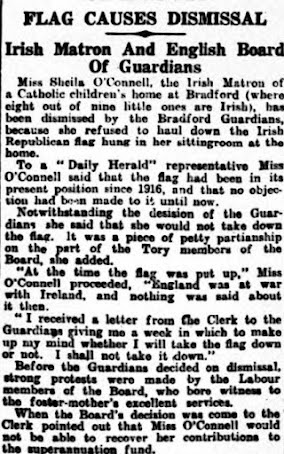
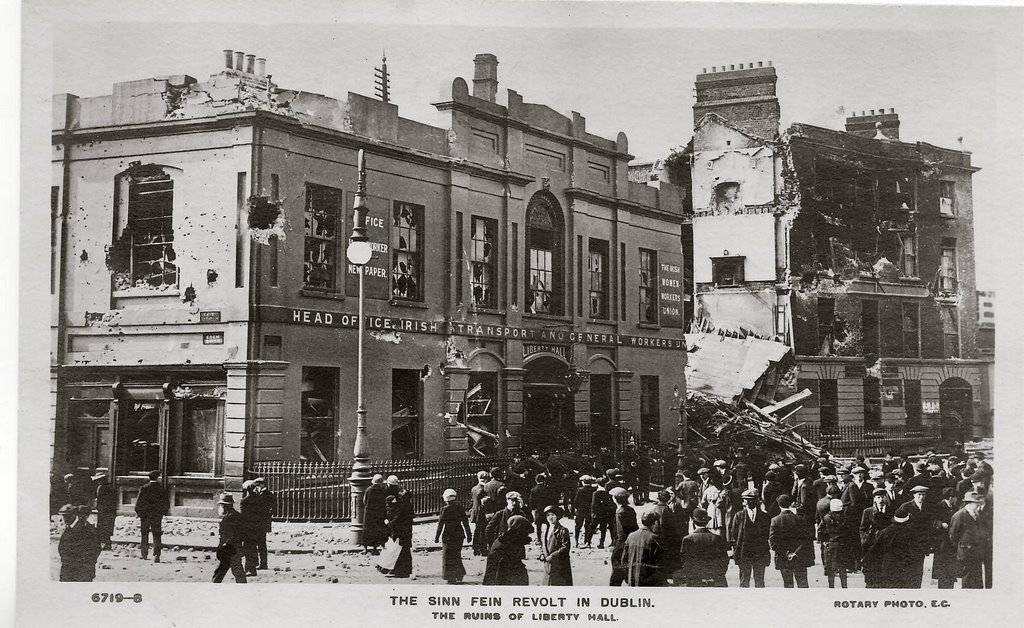
 An Irish republican flag belonging to tho Sheila O'Connell a Matron of a home for children was discussed by Bradford Board of Guardians recently.
It was decided that if the Matron—referred to as the " foster-mother "—declined to remove the flag she should be dismissed. It was stated that the objection to the flag was not that it was Irish, but that it was a rebel flag.
The British Journal of Nursing 3 February 1923
An Irish republican flag belonging to tho Sheila O'Connell a Matron of a home for children was discussed by Bradford Board of Guardians recently.
It was decided that if the Matron—referred to as the " foster-mother "—declined to remove the flag she should be dismissed. It was stated that the objection to the flag was not that it was Irish, but that it was a rebel flag.
The British Journal of Nursing 3 February 1923 Photo Irish Transport & General Workers Union (now SIPTU) headquarters of Citizens Army 1916.
Maude MacCallum - Professional Union of Trained Nurses 1919

Maude MacCallum
Hon Secretary Professional Union of Trained Nurses
Maude MacCallum also known as Miss E Maude MacCallum was the daughter of Mr James W. MacCallum of Dublin Dover
Educated at St Margaret’s Hall, Dublin Trinity College Dublin
She also matriculated at the Royal University of Ireland before entering Nurse Training School Adelaide Hospital Dublin
After obtaining her nursing qualification she joined the Nurses Co-operation then located at 8, New Cavendish Street , London
It was a personal experience which led Miss Maude MacCallum in 1919, to found the Professional union of Trained Nurses, (The first nursing union) for which injustice and tyranny touched her own life she realised how defenseless were many of her colleagues under similar conditions, and with unselfishness singleness of purpose she devoted herself thenceforth to the betterment of the conditions of the “working nurse” and to her protection from unqualified competition when trained.
The PUTN was registered as a Trade union in order to ensure that it should always be managed by nurses themselves.
The Professional Union of Trained Nurses worked closely with the Poor Law Workers Trade Union (later NUCO later COHSE) and MacCallun had her own page in the union’s journal “Monthly Notes”
The Nursing Times, then the Journal of the College of Nursing (RCN) referring to the growth in nursing trade unionism stated “Such a society will attract very few of the best nurses”
We believe the debt of gratitude which they owe her will be increasingly appreciated, as the truth of her favorite motto “Who would be free themselves must strike the blow” becomes more and more understood.
In February 1920, Miss Maude MacCallum was appointed a member of the first General Nursing Council (now Nursing & Midwifery Council NMC) by the minister of Health at the time Christopher Addison MP.
During her term of office she upheld the right of nurses to manage their own affairs and opposed medical and lay domination. She consistently voted for, and spoke in support of, proposals for the benefit of the nursing profession and opposed many recommendations of the majority which she considered inimical to its interest, in spite of derision and rudeness.
Speaking at the Scottish Nurses Club at 205 Bath Street , Glasgow
“Who was afraid of being injured ? . besides, it would not be the nurses themselves who would be hurt by the action, as their conditions were so bad they could hardly be worse; besides, it was not to be expected that so much wrath should be poured forth just to prevent the nurses injuring themselves if they wished to do so. There must be some other interested threatened”.
At the same meeting she also highlighted a historical problem with nurse attitudes to trade unionism “Disabusing the minds of her hearers that trade unionism was synonymous with strikes, which she admitted. It was in her own mind until she went thoroughly into the matter”.
At a meeting of the PUTN on 1st February 1922 at 6 Nottingham Place, it was reported by the Professional Union of Trained Nurses Chairman Mrs Winifrede Paul “seldom have nurses been roused to such a pitch of indignation over anything as they have been at present by the treatment of Mrs Bedford Fenwick and the other independent nurses – including the secretary of the PUTN- have received at the hands of the College of Nursing Ltd”
MacCallun stated in 1923 after the College of Nursing
The Professional Union of Trained Nurses had by July 1921 established an “Alliance 106 Great Russell Street
She suffered from a “corroding disease” (undoubtedly Cancer) which ultimately caused her death, she made no mention of it to her nearest or dearest.
She finally resigned as Honorary Secretary of the Professional Union of Trained Nurses in 1926 on grounds of her health.
In her last few days she was nursed at the Elizabeth Garrett Anderson Hospital 14th June 1926 .
Her service was held at St Pancras Church and was conducted by Rev Prebendary Metcalfe and Rev W.E. Kingsbury Secretary of the Actors Union.
Suspended at the lower end of the coffin was a laurel wreath with roses and a message “in loving remembrance from the PUTN” tied with its colours.
Notes from various publications incl the British Journal of Nursing
by Michael Walker UNISON
Photo of MacCallum from The British Journal of Nursing July 1926
Read Sarah Claridge PUTN and NUCO posting on this site
Kate L Earp (was this Mrs Atherton Earp ? trained at Crumpsall Infirmary, Manchester, child welfare Paris, Educational organiser Infant Welfare Centre, Hampstead,)
Professional Union of Trained Nurses established in 1920 with 268 members. The union ceased to exist by 1930
Tuesday, April 25, 2006
ITGWU Irish Nurses Deal 1956
In our last issue we reported on the threatened stoppage of work by the mental hospital nursing staffs throughout the country following the failure of negotiations to resolve the matters at issue.
The Council's deliberation resulted in the following agreement :—
(1)that a permanent body on thelines of a Joint Industrial Council be established immediately to consider future claims relating to salaries and conditions of service of nursing and attendant staffs.
(2) that the following national salary scales apply to mental nursing and attendant staffs (exclusive of senior nursing posts):
Male attendants — £290+£5 to £305.
Male nurses — £345+£10 to £395, to £405 after 11 years, to £410 after 15 years, and to £415 after 20 years.
Female attendants—£265+£4 to £277
Female nurses — £305 + £10 to £365 and to £375 after 20 years
In addition to these scales £25 p.a. is payable to a Deputy Charge nurse and £45 p.a. to Charge nurses.
Cost of living allowances granted on a national basis on and after
It is accepted by the Provisional Council that any of the parties may submit at any future date for consideration and determination by the Council a proposal for the amending of the above salary scales on a national basis and further, that any of the parties may submit at any time for consideration and determination bv the Council claims in respect of conditions of employment and service such as overtime conditions and payments and problems in respect of supervision and overcrowding.
Nothing herein contained shall prejudice in any way any personal plus allowances already being paid in any district mental hospital.
The Council agrees that the scales set out above shall be payable
on and from 1st December, 1955.
ITGWU (SIPTU)
Sunday, April 23, 2006
Irish nurses strike 1980 and 1999
The Irish experience of strike action first occurred in 1980 over a pay dispute.
It lasted 17 days and mostly involved nurses belonging to SIPTU (then known as the Irish transport & General Workers Union - ITGWU)
According to ITGWU Nursing Officer Pat Brady the strike action was successful in that it achieved a major pay increase for nurses.
the union also recruited substantial number of members from the Irish Nurses Organisation (then like the RCN a no strike union)
IRISH NURSES STRIKE 1999
On
Members of all four nursing unions backed the strike by massive majorities on October 11. They rejected an offer by the
SIPTU nurses voted 82 percent in favor of strike action, and the Irish Nurses Organisation, voted 96 percent in favor. While smaller unions IMPACT and the Psychiatric Nurses Association members backed the action by 89 percent.
27,000 nurses began on
The government, for its part, was fearful that further concessions would provoke "knock-on" pay claims elsewhere in the public sector. For this reason, the government was resolute in its determination to face down the nurses, partly in an attempt to dissuade other public sector workers from pressing their own claims. The strike was called off after nine days, after the nurses had secured some concessions that exceeded the terms previously offered following a
Friday, April 21, 2006
Patrick McHugh - St Pancras Hospital
Patrick McHugh
Born in Ireland 45 years service
Chief Male Nurse at St Pancras Hospital (Observation Unit - psychiatric )
Joined The National Union of County Officers (NUCO) union (Later COHSE) in 1925. He took a leading part in the early struggles to improve nursing service conditions and was part of the first public demonstration by nurses, when NUCO nurses took part in the "raid on the LCC", when leaflets were thrown into London County Council chamber to highlight LCC Nurses grievances. Patrick also took part in the famous "masked demonstration" by NUCO uniformed nurses, who march down Fleet Street on the 5th April 1938 with sandwich boards stating "we demand fair pay" and a 48 hour week.
speaking in February 1937 Patrick McHugh for NUCO stated
"that the Nursing Executive of the National Union of County Officers were unanimously of opinion that nursing of the Chronic Sick should be done by fully trained nurses. If employing authorities could be persuaded to give more reasonable rates of pay, shorter working hours, and improved conditions, it would go a long -way towards removing the difficulty in obtaining the general trained nurse."
Probably trained initially in Dublin
Served in France in the RAMC in WW1
A member of NUCO's National Executive Committee
Considered "A remarkable gift of oratory"
his motto was "Let this day pass no one by"
Member of the board of Governors at the National hospital, Queen's Square
Retired 1952
Died June 29th 1954
Possible
Born 15th May 1887 at Abbeyleix, Laois, Ireland to Thomas McHugh and Mary Keelly. Patrick McHugh married Mary Nevin and had 5 children.

Subscribe to:
Posts (Atom)