Thursday, December 03, 2009

Big Bonuses in the City - Nurses Face Pay Freeze

Stand up to Bankers' Blackmail

Thursday 03 December 2009

Unison leader Dave Prentis has said bankers should "come down to earth and realise their world has changed"

Unison leader Dave Prentis has said bankers should "come down to earth and realise their world has changed"

Trade unions have urged the government to reject Royal Bank of Scotland bosses' blackmail and call their bluff over massive bonus plans.

The bank's board has threatened to quit if the Treasury blocks plans to pay out bonuses to its staff to the tune of £1.5 billion, despite having had to be bailed out to the tune of billions of pounds by the taxpayer.

TUC general secretary Brendan Barber warned that the threats proved that nothing had been learned from the economic collapse only last year.

"The banks nearly brought down the whole economy only a year ago. Few would have survived without government or Bank of England help," he said.

"Yet now we learn that they are back to the bad old days when they confused their telephone numbers with what they were paid.

"Surely there must be a limit to the amount of champagne that even a banker can consume in a year?"

Unison general secretary Dave Prentis described directors at the bank a "disgrace" and called on them to "come down to Earth and realise their world has changed."

He said that, despite banks and financial institutions causing a collapse that has forced many thousands onto the dole, plenty of those claiming benefits would be happy to be able to find a fair day's work for a fair day's pay.

"It is outrageous that millionaire bankers are trying to blackmail taxpayers into paying them multimillion-pound bonuses," added Unison Greater London nursing officer Michael Walker at the union's London Nursing Conference in Lewisham.

"Nurses on many wards could state that, without a significant pay rise, they may be forced to leave nursing and therefore patient care could suffer.

"Yet nurses are not offered a pay rise, they are facing the threat of a pay freeze from millionaire Tories."

And Left Economics Advisory Panel co-ordinator Andrew Fisher added: "The government should respond to this blackmail with one word. Goodbye."

But the government responded with very mixed signals.

Chancellor Alistair Darling warned that he was prepared to veto the size of the bank's bonus pool after City Minister Lord Myners warned that at least 5,000 bankers would pocket more than £1 million each this year unless action was taken.

Lord Myners said there was "precious little evidence" that people at the top of the banks appreciated the "concern about these extraordinary levels of income."

He called on major shareholding institutions to tackle the issue immediately, before it was too late.

However, Business Secretary Lord Mandelson struck a different note, expressing support for the board and appearing to contradict the earlier stance taken by the Treasury.

"I understand the point of view that Royal Bank of Scotland directors are expressing - they have to remain competitive in the market in recruiting senior executives," he said, adding that bonuses "form an integral part" of remuneration packages for senior staff, although he urged banks to exercise restraint voluntarily.

A spokesman for the bank merely claimed that bonuses were necessary to operate in "competitive markets."


Morning Star

Monday, November 16, 2009

Jessie Ritchie - WW1 QAIMNS

DUNDEE NURSES
KILLED IN WW1

Jessie Ritchie


Cargill, Blairgowrie, Perthshire, Scotland.
Sister of James Ritchie of The Neuk, Rosemount Blairgowrie, Pertshire, Scotland.

Trained at the Royal infirmary Dundee Scotland.

later worked for the Nurses Co-operative in London based at Cavendish Square.

Served in the Boer War and was the Matron at the Orange River (concentration) Refugee Camp 1902.

Meet General Smuts on 2nd June 1902.

Joined the British Expeditionary Forces in France during the first days of World War One as a Staff Nurse in the Queen Alexandra's Imperial Military Nursing Service, transfered to Egypt and later to the Salonika front in Greece.

Died of dysentery 13th August 1916

Buried: Salonika Lembet Road Cemetery
The Cemetery is on the northern outskirts of Thessalonika, Greece

Commemorated on Wolfill Village Hall, Perthshire Memorial


AGNES GREIG MANN

Dundee Staff Nurse: AGNES GREIG MANN QAIMNS aged 25, drowned as a result of the German U boat mining of the H.M.H.S. "Salta." 10th April 1917 buried Ste. Marie Cemetery, Le Havre;

Friday, November 13, 2009

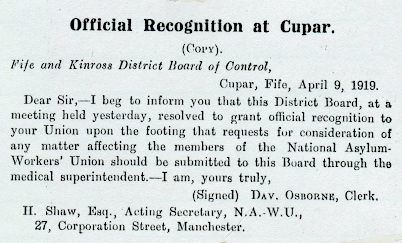
WW1 National Asylum Workers Union

National Asylum Workers Union

Private Fred Cartmell; 8th Battalion King's Own Royal Lanacter Regiment, Rainhill Asylum staff and union member


He was invalided home early in from wounds received in September 1917 returned to the front and was killed in action 26/09/1917 aged 27. Husband of Emma Cartmell 25 New Road, Rainhill, Lancashire, Tyne Cot Cemetery.

Private Frederick Curtis; 1st battalion Welsh Guards active union member at Maidstone Mental Hospital, killed in France July 31st 1917 aged 32. Duhallow Cemetery. Son of Elizabeth Waterman, Edinburgh Villa, Barming Heath, Maidstone.

Sergeant Oliver; 2nd North Midlands Royal Garrison Artillery. died in hospital in France aged 32 on 27/08/1917 mentioned in dispatches, Dozinghem cemetery . He was a reservist at outbreak of the War an an attendant at Wakefield Asylum and a member of the local union branch. Husband 12 Denstone Street, Mount Pleasant, Wakefield. Son of Louis Kossuth Batty.

Private H. Wilson; (Charles Henry Wilson) 8th East Surrey Regiment was killed in action at Messines Ridge near Ypres on July 23rd 1917, buried at Ypres Menin Gate, union member at Napsbury Hospital
.

Thursday, November 05, 2009

First Hospital Ship 1862


The first hospital ship used during war time, came into service during the American Civil War.

The USS Mound City had captured the "Red Rover" from the Confederates on 7 April 1862 and the ship was later turned into a hospital ship, USS Red Rover on the Mississippi.

The ships medical crew included a complement of Catholic Sisters of the Holy Cross nurses and a section Afro-American nurses.

Renamed the hospital ship "Red Rover" she was placed in service of the U.S. Army's Western Gunboat Flotilla in June 1862. Hospital Ship "Red Rover" served on the Mississippi in this role through the summer of 1862,


We know the names of at least four nurses -
Alice Kennedy, Sarah Kinno, Ellen Campbell and Betsy Young.

The nursing staff aboard the "Red Rover" represented the first US Navy nurses and some of the first recognised Afro American nurses
.

Wednesday, November 04, 2009

Henrietta Mellett and Canadian Nurses WW1

Henrietta Mellett

Irish-Canadian Nurse

By Marc Leroux

Sometimes fate gives us a chance to do things that we might otherwise miss.

A couple of weeks ago I was updating the cause of death for all the Nursing Sisters in the Canadian Great war Project. When I got to Henrietta Mellett, I noticed that the Cause of Death in Ed Wigneys Roll of Honour was listed as “Drowning”.

Henrietta Mellett was born in Galway, Ireland October 21, 1883, and enlisted into the Canadian Army Medical Corps (No 15 General Hospital) at London, Ontario on 22nd January 1918 . She appears on the 1911 Census, so she immigrated to Canada sometime prior to 1911.

As with any attempt to reconstruct events from over 90 years ago, there is some degree of speculation, but it is likely that her family had moved from Galway to Dublin and was living there in 1918. It is likely that Henrietta Mellett was returning to England on 10 October 1918 after visiting them. She was aboard the mailboat R.M.S. Leinster, with a crew of 77 and 694 passengers, bound for Holyhead, Wales when it was attacked and sunk by the German submarine UB-123 just before 10:00 AM. The Leinster went down about 6 km outside of Dublin Bay. The official loss of life was 501 personnel, and it was possibly higher.

Fate came in to play when I saw that her body had been recovered and she was buried in Dublin. My wife and I were planning an Irish vacation, so last Tuesday, 3 weeks after looking up her cause of death, on a drizzly morning, I found myself in Mt. Jerome Cemetery in Dublin. I located her grave, as well as the grave of Private Fryday, the only other Canadian buried there. Nursing Sister Mellette is buried with her brother and sister, with the Commonwealth War Graves Commission marker atop the grave.

It is very satisfying to be able to be fortunate enough to have found that she was buried there, and to be able to make the trip to the Cemetery to honour her memory.

Canadian Nurses WW1

By Michael Walker

Canadian Nurses who died WW1

46 of the 3,000 women who served as "nursing sisters" in the Canadian Army Medical Corps lost their lives during the war. Of info available, six were killed or mortally wounded (of which three died in the deliberate bombing of the military hospital in Étaples, France);

15 died at sea, with the sinking of the hospital ship, Llandovery Castle; 15 died of disease; and seven died later in Canada


AN IMPRESSIVE CEREMONY 1920.


Short, simple and deeply impressive was the ceremony, says The Canadian Nurse, which took place in the wide corridor just outside the Legislative Chamber of the Parliament Buildings, Toronto, when the memorial tablet to the memory of the nurses of the Ontario Military Hospital, Orpington, Kent, England, who gave their lives during the war, was unveiled by Major Margaret C. MacDonald, R.R.C. Matron-in-Chief of the Canadian overseas military forces
.


Family and many persons of note attended the ceremony. Present for the occasion were the near relatives of the heroines whose names appear on the tablet :

Nursing Sister Mary McKenzie,
formerly of Toronto, who was drowned in the sinking by the enemy of the hospital ship Llandovery Castle;


Nursing Sister S. E. Garbutt,
who went overseas for service in June, 1917(?), and died of cancer the following (20th August 1917);


Nursing Sister M. Lowe,
Of Binscarth, Manitoba, who was killed during the bombing outrages at Etaples in May, 1918 ; (28th May 1918)


Nursing Sister D. H. Baldwin,
who died as a result of wounds received during the enemy raids at. Doulens, France, in May, 1918 ; (30th May 1918)


Nursing Sister M. E. Greene,
who died of double pneumonia, at No. 24 British General Hospital, Etaples, France, in October, 1918. (9th October 1918)

Hon. Dr. H. J. Cody, former Minister of Education, read the memorial service and dedicated the tablet, erected by the matron and nursing sisters of the Orpington (Canadian) Hospital unit.

May 29 1920 British Nursing Journal ROLL OF HONOUR NURSES CANADA WORLD WAR ONE CANADIAN ARMY MEDICAL CORPS

Alpaugh. A
Baker. M. E
Baker. M. E
Bolton
. G. E.
Campbell
. C.
Champagne
. E.
Cumming. I.
Dagg. A. St. C.
Donaldson. G.
Douglas
. C. J.
Dussault. A.
Follette. M. A.
Forneri. A. F.
Fortescue. M. J.
Fraser. M. M.
Frederickson. C.
Gallaher. M. K.
Grant.G. M.
Herman .V. B.
Henshaw. I.
Hunt. M.
Jaggard. J. B.
Jarvis. J.
Jenner. L. M.
Kealy. I. L.
King. J. N.
MacIntosh. R.
MacLeod. M.
McDiarmid .J. M.
McDougall .A.
McEachen. R.
McGinnis. M. G.
McKay. E. V.
McKenzie. M. A.
McLean
. R. M.
Mellett. H.
Munro. M. F. E
Roberts. J.
Rogers. N. G.
Ross. A. J.
Ross E. G.
Sampson. M. B.
Sare. G. I.
Sparks. E.
Stamers. A. I.
Templeman. J.
Trusdale. A.
Tupper. A. A.

CANADIAN ARMY NURSING SERVICE

Baldwin. G (30 May 1918) wounds
Davis
. L.A (21 February 1918) K/N
Garbutt S. E (20 August 1917) K/N
Green. M (9 October 1918) Disease
Lowe. M (28 May 1918) wounds
MacDonald. K.M. (19 May 1918) wounds
MacPherson. A (30 May 1918) wounds
Pringle. E.L (30 May 1918) wounds
Wake. Gladys M.M (21 May 1918) wounds

Whitely. A (21 April 1918) wounds

SINKING OF THE LLANDOVERY CASTLE

At the end of the month of June 1918, the "LLANDOVERY CASTLE" was on her way back to England from Halifax. She has on board the crew, consisting of one hundred and sixty-four men, eighty officers and men of the Canadian Medical Corps, and fourteen nurses, a total of two hundred and fifty-eight persons. There were no combatants on board. The vessel had not taken on board any munitions or other war material. This has been clearly established.

In the evening of 27th of June, 1918, at about nine-thirty (local time) the "LLANDOVERY CASTLE" was sunk in the Atlantic Ocean, about one hundred and sixteen miles south-west of Fastnet (Ireland), by a torpedo from the German U-boat 86. Of those aboard only twenty-four persons were saved, two hundred and thirty-four having been drowned.


For a superb account of nurses in WW1 read "It's a long way to Tipperary " (British & Irish nurses in the Great War) by Yvonne McEwen


Michael Walker

UNISON The Nursing Union - London

Tuesday, October 20, 2009

Royal Surrey County Hospital - Sports Day circa 1982

Tangley/Tilford ward new Royal Surrey County Hospital, Simply the best staff and ward at RSCH in the 1980's solid COHSE, many ex Milford Chest Hospital nurses

I salute you all and hope your doing well


at least one important nurse missing from this picture

Saturday, August 22, 2009

Nurses Strike - Gweedore - Donegal Gaeltacht


SIPTU NURSES TO STRIKE
IN DONEGAL

21 Aug 2009

SIPTU members to take industrial action at Gweedore Nursing Home in the Donegal Gaeltacht (Ireland's largest Irish speaking area)


Members of SIPTU at the Bainistiocht Aras Gaoth Dobhair Teoranta nursing home in Gweeedore County Donegal are taking industrial action in pursuit of their claim for terms and conditions of employment comparable to similar grades in the Health Service Executive
(HSE). The initial stoppage is for 24 hours on September 1 and the Union says it will do everything possible to avoid discomfort to patients if the action goes ahead.

Aras Gaoth Dobhair, a 41 bed community nursing home, was set up in 2004 on a partnership basis between the HSE, Udarás na Gaeltacht and a local community group. The Director of Service at the nursing home is a HSE employee, while two community care managers are nominated by the HSE to sit on the management committee of the nursing home.

“However, SIPTU members, who comprise the majority of the 47 employees and work in the administrative and maintenance areas, do not enjoy the same terms and conditions of employment as similar grades within the HSE”, Branch Organiser, Martin O’Rourke said today. He added that Union members have waited patiently for over three years to have their employment issues resolved.

“In July, the Labour Court recommended very marginal improvements which do not resolve the issues of concern to our members. The Court’s recommendations on pensions, sick pay and shift allowances were overwhelmingly rejected as completely inadequate and far short of what HSE employees enjoy,” he said.

“SIPTU issued notice of industrial action to the company on August 6, 2009 to allow it the best possible opportunity to resolve the dispute. Regretfully, we have yet to received any meaningful proposals which might resolve the outstanding issues.

“Many of the clients are vulnerable and elderly and for that reason we have decided to limit the initial action to one 24-hour period commencing at 8.00am on Tuesday, September 1 until 8.00am on Wednesday, September 2. ” he said. “If the strike goes ahead, every effort will be made to avert possible discomfort clients.”

He stressed that SIPTU remains available for talks, “But it is not fair, reasonable nor acceptable that all employees do not enjoy the same terms and conditions of employment as similar grades within the HSE who do exactly the same work. Frankly, our members deserve better than this.”

NOTE

SIPTU/ITGWU has for many years a strong base amongst nurses in Donegal, starting with nurses at Letterkenny Mental Hospital thanks to the work of ITGWU pioneers such as Peadar O'Donnell (Irish speaker born at Meenmore, Dugloe, Co Donegal) appointed ITGWU organiser in
1918.

John Nugent was elected as ITGWU branch secretary in 1947 at Letterkenny Mental Hospital.

The ITGWU had members in Donegal from the beginnings of the union in 1909, while Peadar O'Donnell had increased membership, by 1920 Donegal had just four branches Donegal town, Letterkenny, Ballyshannon and Dugloe (?). It was not until the organisation of workers at a Woollen Mill at Convoy, the largest private employer in the county that membership took off.

The first branch Secretary of the Convoy branch was John Anthony McElhinney.